MCQ
In the sixth period, the orbitals being filled are :-
  • A
    $5s, 5p, 5d$
  • B
    $6s, 6p, 6s, 6f$
  • C
    $6s, 5f, 6d, 6p$
  • $6s, 4f, 5d, 6p$

Answer

Correct option: D.
$6s, 4f, 5d, 6p$
d
In the sixth period $( n =6)$ of the periodic table, $6 s , 4 f , 6 d , 6 p$ orbitals are filled in the increasing order of the energy. A total of $16$ orbitals are available each of which contains a maximum of $2$ electrons. Thus, a total of $32$ electrons can be accommodated.

Need a full question paper?

Generate a complete, print-ready paper with questions like this in minutes — across 16+ boards, with answer keys.

Start Generating Free

Similar questions

Formation of alkane by the action of $Zn$ on alkyl halide is called
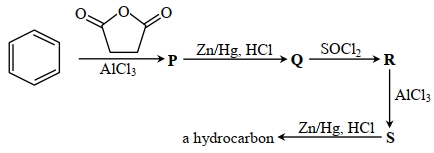
Considering the following reaction sequence, the correct statement(s) is(are)

$(A)$ Compounds $P$ and $Q$ are carboxylic acids.

$(B)$ Compound $S$ decolorizes bromine water.

$(C)$ Compounds $P$ and $S$ react with hydroxylamine to give the corresponding oximes.

$(D)$ Compound $R$ reacts with dialkylcadmium to give the corresponding tertiary alcohol.
Which one of the following properties of an element is not variable
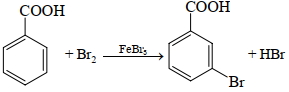
Consider the above reaction where $6.1 \,g$ of benzoic acid is used to get $7.8\, g$ of $m$ -bromo benzoic acid. The percentage yield of the product is ....... .

(Round off to the Nearest integer) [Given : Atomic masses : $C =12.0 \,u , H : 1.0\, u,O : 16.0 \,u , Br =80.0 \,u ]$
A compound contains $10^{-2} \%$ of phosphorus. If atomic mass of phosphorus is $31$,  the molecular mass of the compound having one phosphorus atom per molecule is  :-
A hydrocarbon $X$ adds on one mole of hydrogen to give another hydrocarbon and decolourised bromine water. $X$ reacts with $KMn{O_4}$ in presence of acid to give two moles of the same carboxylic acid. The structure of $X$ is
In which of the following pairs the difference between the covalent radii of the two metals is maximum
At $67\,^oC$ and $1\ bar$ pressure, dinitrogen tetra oxide is $50\%$ dissociated into nitrogen dioxide. $\Delta {G^o}$ for the process

$2N{O_2}\left( g \right) \rightleftharpoons {N_2}{O_4}\left( g \right)$ is

$\left( {R = \frac{{25}}{3}J/K.mol,\ln 2 = 0.7,\ln 3 = 1.1} \right)$

The $\Delta H_f$ for $CO_{2(g)},\,CO_{(g)}$ and $H_2O_{(g)}$ are $-393.5,\,-110.5$ and $-241.8\,KJ$ respectively. The standard enthalpy change for this reaction is

$C{O_{2(g)}} + {H_{2(g)}} \to C{O_{(g)}} + {H_2}{O_{(g)}}$ .....$KJ$
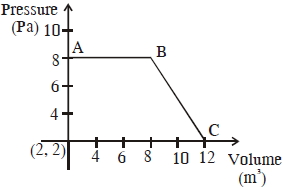
The magnitude of work done by a gas that undergoes a reversible expansion along the path $ABC$ shown in the figure is .............. $\mathrm{Joule}$