MCQ
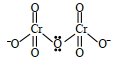
In the structure of the dichromate ion, there is a :
  • A
    linear symmetrical $\mathrm{Cr}-\mathrm{O}-\mathrm{Cr}$ bond.
  • non-linear symmetrical $\mathrm{Cr}-\mathrm{O}-\mathrm{Cr}$ bond.
  • C
    linear unsymmetrical $\mathrm{Cr}-\mathrm{O}-\mathrm{Cr}$ bond.
  • D
    non-linear unsymmetrical $\mathrm{Cr}-\mathrm{O}-\mathrm{Cr}$ bond.

Answer

Correct option: B.
non-linear symmetrical $\mathrm{Cr}-\mathrm{O}-\mathrm{Cr}$ bond.
b
dichromate ion contain non-linear symmetrical $\mathrm{Cr}-\mathrm{O}-\mathrm{Cr}$ Bond

Need a full question paper?

Generate a complete, print-ready paper with questions like this in minutes — across 16+ boards, with answer keys.

Start Generating Free

Similar questions

A reaction takes place in three steps with individual rate constant and activation energy as follows 

     Rate constant     Activation energy
 Step $1$        $k_1$ $E_{a1} = 180\ kJ/mol$
 Step $2$        $k_2$ $E_{a2} = 80\ kJ/mol$
 Step $3$        $k_3$ $E_{a3} = 50\ kJ/mol$

If overall rate constant, $k = {\left( {\frac{{{k_1}{k_2}}}{{{k_3}}}} \right)^{2/3}}$  ,then overall activation energy of the reaction will be  .......... $ kJ/mol$

Point out the incorrect synthesis
$Na_2S_2O_3.5H_2O$ is used in photography to
Vitamin $B _1$ is :
The difference in electronegativity of carbon-halogen bond is minimum in:
The correct IUPAC name for $\text{CH}_2=\text{CHCH}_2\text{NHCH}_3$ is:
Consider a $70 \%$ efficient hydrogen-oxygen fuel cell working under standard conditions at 1 bar and $298 K$. Its cell reaction is

$H _2( g )+\frac{1}{2} O _2( g ) \rightarrow H _2 O (\ell)$

The work derived from the cell on the consumption of $1.0 \times 10^{-3} mol$ of $H _2( g )$ is used to compress $1.00 mol$ of a monoatomic ideal gas in a thermally insulted container. What is the change in the temperature (in $K$ ) of the ideal gas ?

The standard reduction potentials for the two half-cells are given below.

$\left. O _2( g )+4 H ^{+} \text {(aq. }\right)+4 e ^{-} \rightarrow 2 H _2 O (\ell), E ^{\circ}=1.23 V,$

$\left.2 H ^{+} \text {(aq. }\right)+2 e ^{-} \rightarrow H _2( g ), E ^{\circ}=0.00 V.$

Use $F =96500 C mol ^{-1}, R =8.314 J mol ^{-1} K ^{-1}$
Lucas test is used for
At $25\,^oC$ , the molar conductivity at infinite dilution for electrolytes $KOH, KCl$ and $BaCl_2$ are $248 \times 10^{-4}, 126 \times 10^{-4}$ and $280 \times 10^{ -4}\,Sm^2\,mol^{-1}$ respectively calculate $\Lambda _m^\infty $ for $Ba(OH)_2$ (in $Sm^2\, mol^{-1}$ )
Acetic anhydride is obtained from acetyl chloride by the reaction of