MCQ
In the Young's double slit experiment, if the phase difference between the two waves interfering at a point is $\varnothing$, the intensity at that point can be expressed by the expression $($Where $A$ and $B$ depend upon the amplitudes of the two waves$)$
  • A
    $I=\sqrt{A^2+B^2 \cos ^2 \emptyset}$
  • B
    $I=\frac{A}{B} \cos \varnothing$
  • C
    $I=A+B \cos ^{\frac{\emptyset}{2}}$
  • $I =\mathrm{A}+\mathrm{B} \operatorname{Cos} \varnothing$
Answer

Correct option: D.
$I =\mathrm{A}+\mathrm{B} \operatorname{Cos} \varnothing$

Need a full question paper?

Generate a complete, print-ready paper with questions like this in minutes — across 16+ boards, with answer keys.

Start Generating Free

Similar questions

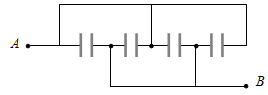
Four condensers are joined as shown in the adjoining figure. The capacity of each is $8 \mu F$. The equivalent capacity between the points $A$ and $B$ will be
The composition of an a -particle  can be expressed as(a) 1 P + 1 N  (b) 1 P + 2 N (c) 2 P + 1 N (d) 2 P + 2 N
       
The S.I. unit of electric flux is:
A laser beam can be focussed on an area equal to the square of its wavelength A $He-Ne$ laser radiates energy at the rate of $1\ mW$ and its wavelength is $632.8\ nm.$ The intensity of focussed beam will be
The ratio of the intensity at the centre of a bright fringe to the intensity at a point one-quarter of the distance between two fringe from the centre is(a) 2 (b) 1/2(c) 4  (d) 16
       
Assertion  :  In transistor common emitter mode as an amplifier is preferred over common base mode.
Reason     : In common emitter mode the input signal is connected in series with the voltage applied to the base emitter function.(a) If both assertion and reason are true and the reason is the correct explanation of the assertion.(b) If both assertion and reason are true but reason is not the correct explanation of the assertion.(c) If assertion is true but reason is false.(d) If the assertion and reason both are false.


If a proton is projected in a direction perpendicular to a uniform magnetic field with velocity v and an electron is projected along the lines of force, what will happen to proton and electron(a) The electron will travel along a circle with constant speed and the proton will move along a straight line(b) Proton will move in a circle with constant speed and there will be no effect on the motion of electron(c) There will not be any effect on the motion of electron and proton(d) The electron and proton both will follow the path of a parabola


In series L - C - R resonant circuit, to increase the resonant frequency:
Two metal pieces having a potential difference of $800 V$ are $0.02 m$ apart horizontally. A particle of mass $1.96 \times 10^{-15} \ kg$ is suspended in equilibrium between the plates. If $e$ is the elementary charge, then charge on the particle is
The ionisation energy of hydrogen atom is 13.6 eV. Following Bohr's theory, the energy corresponding to a transition between the 3rd and the 4th orbit is(a) 3.40 eV(b) 1.51 eV(c) 0.85 eV(d) 0.66 eV