MCQ
In traslational equilibrium:
  • A
    $\sum^\limits{\text{n}}_\limits{\text{i}=1}\text{F}_{\text{net}}=0$
  • B
    $\sum^\limits{\text{n}}_\limits{\text{i}=1}\tau_{\text{net}}=0$
  • C
    Both (a) and (b) are the necessary conditions for the translational equilibrium.
  • D
    Particle may be in equilibrium when (a) and (b) are not fulfilled.
Answer

  1. $\sum^\limits{\text{n}}_\limits{\text{i}=1}\text{F}_{\text{net}}=0$

Need a full question paper?

Generate a complete, print-ready paper with questions like this in minutes — across 16+ boards, with answer keys.

Start Generating Free

Similar questions

A soap bubble is blown to a diameter of $7 \mathrm{~cm}$. $36960 \mathrm{erg}$ of work is done in blowing it further. If surface tension of soap solution is $40 \mathrm{dyne} / \mathrm{cm}$ then the new radius is______. $\mathrm{cm}$. Take $:\left(\pi=\frac{22}{7}\right)$.
A sniper fires a rifle bullet into a gasoline tank making a hole $53.0 m$  below the surface of gasoline. The tank was sealed at $3.10 atm$. The stored gasoline has a density of $660 kgm^{-3}$. The velocity with which gasoline begins to shoot out of the hole is........ $ms^{-1}$
Calculate the value of mean free path $(\lambda)$ for oxygen molecules at temperature $27^{\circ}\, C$ and pressure $1.01 \times 10^{5} \,Pa$. Assume the molecular diameter $0.3 \,nm$ and the gas is ideal. $\left( k =1.38 \times 10^{-23}\, J\,K ^{-1}\right)$ (in $nm$)
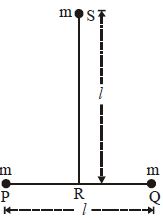
Two particles each of mass $m$ are placed at points $P$ and $Q$ as shown in the figure. $R$ is the mid-point of $PQ = l$. The gravitational force on the third particle of mass $m$ placed at point $S$ on the perpendicular bisector of $PQ$ is
If the body is moving in a circle of radius $ r$ with a constant speed $v$, its angular velocity is
The position $x$ of a particle with respect to time $t$ along $x-$axis is given by $x = 9{t^2} - {t^3}$ where $x$ is in metres and $t$ in seconds. What will be the position of this particle when it achieves maximum speed along the $x$ direction ?..........$m$
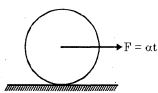
A sphere of mass $m$ and radius $R$ is kept on arough horizontal surface and pulled with a horizontal force $F = \alpha\ t$ where $\alpha$  is a constant and $t$ is time. The coefficient of static friction is $μ_s$ and coefficient of kinetic friction is $μ_k$ . Which of the following graph correctly shows the variation of acceleration of sphere with time ?
In a tonga, horse pulls a wagon. Which is the correct analysis of the situation?
An electric current i enters and leaves a uniform circular wire of radius a through diametrically opposite points. A charged particle q moving along the axis of the circular wire passes through its centre at speed v. The magnetic force acting on the particle when it passes through the centre has a magnitude:

  1. $\text{qv}\frac{\mu_0\text{i}}{2\text{a}}$

  2. $\text{qv}\frac{\mu_0\text{i}}{2\pi\text{a}}$

  3. $\text{qv}\frac{\mu_0\text{i}}{\text{a}}$

  4. $\text{Zero}$

Write the dimensions of $a/b$ in the relation $P = \frac{{a - {t^2}}}{{bx}}$ , where $P$ is pressure, $x$ is the distance and $t$ is the time