Question
In $\triangle\text{ABC}$ and 6PQR, AB = PR and $\angle\text{A}=\angle\text{P}.$ Then, the two triangles will be congruent by SAS axiom if:

Answer

  1. AC = PQ
    Solution:
    $\angle\text{A}$ is included between AB and AC and LP is included between PQ and PR and corresponding sides must be equal. Since AB = PR, hence AC = PQ for the given triangles to be congruent by SAS axiom.

Need a full question paper?

Generate a complete, print-ready paper with questions like this in minutes — across 16+ boards, with answer keys.
Start Generating Free

Similar questions

The value of $(\sqrt{\text{x}}+\sqrt{\text{y}})(\sqrt{\text{x}}-\sqrt{\text{y}})(\text{x}+\text{y})(\text{x}^2+\text{y}^2)$ is:
Write the correct answer in the following:
Between two rational numbers.
In the given figure, O is the centre of a circle. If $\angle\text{AOB}=100^\circ$ and $\angle\text{AOC}=90^\circ$ then $\angle\text{BAC}=?$
The sides of a triangle are 11m, 60m and 61m. The altitude to the smallest side is:
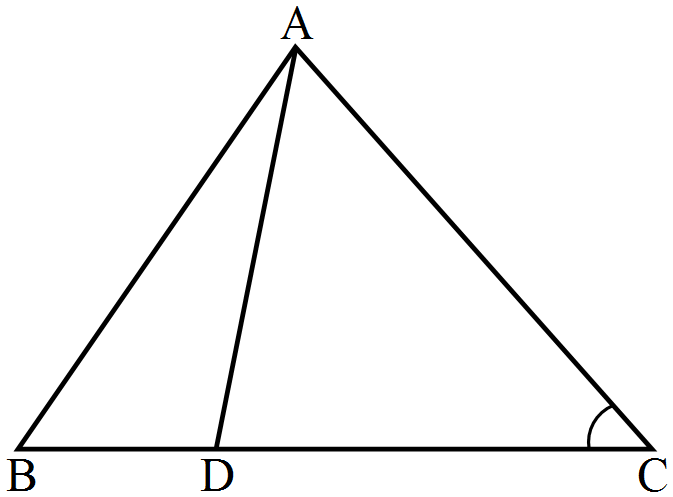
In the given figure, AB > AC. Then which of the following is true?
  1. AB < AD
  2. AB = AD
  3. AB > AD
  4. Cannot be determined
The incorrect statement is:
  1. Two lines drawn in a plane always intersect at a point.
  2. A line segment has definite length.
  3. Three lines are concurrent if and only if they have a common point.
  4. One and only one line can be drawn passing through a given point and parallel to a given line.
    From the choices given below mark the co-prime numbers.
    In the following, write the correct answer.
    If AB = QR, BC = PR and CA = PQ, then:
    1. $\triangle\text{ABC}\cong\triangle\text{QRP}$
    2. $\triangle\text{CBA}\cong\triangle\text{PRQ}$
    3. $\triangle\text{BAC}\cong\triangle\text{RQP}$
    4. $\triangle\text{PQR}\cong\triangle\text{BCA}$ 
    In $\triangle\text{ABC}$ and $\triangle\text{PQR},$ it is given that AB = AC, $\angle\text{C}=\angle\text{P}$ and $\angle\text{B}=\angle\text{Q}.$ Then, the two triangles are:
    1. Isosceles but not congruent
    2. Isosceles and congruent
    3. Congruent but not isosceles
    4. Neither congruent nor isosceles
    The area of the figure formed by joining the mid-points of the adjacent sides of a rhombus with diagonals $16\ cm$ and $12\ cm$ is: