Question
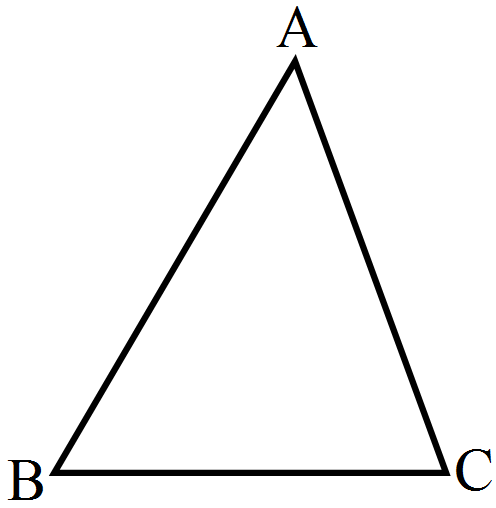
In $\triangle\text{ABC},$ if $\angle\text{A}=40^\circ$ and $\angle\text{B}=60^\circ.$ Determine the longest and shortest sides of the triangle.
Answer

Given that in $\triangle\text{ABC},\angle\text{A}=40^\circ$ and $\angle\text{B}=60^\circ$

We have to find longest and shortest side
We know that,
Sum of angles in a triangle 180°
$\angle\text{A}+\angle\text{B}+\angle\text{C}=180^\circ$
$40^\circ+60^\circ-\big((10)0^\circ\big)=180^\circ$
$\angle\text{C}=180^\circ$
Now,
$\Rightarrow40^\circ<60^\circ<80^\circ=\angle\text{A}<\angle\text{B}<\angle\text{C}$
$\Rightarrow\angle\text{C}$ is greater angle and $\angle\text{A}$ is smaller angle.
Now, $\angle\text{A}<\angle\text{B}<\angle\text{C}$
$\Rightarrow\text{BC}<\text{AAC}<\text{AB}$ [Side opposite to greater angle is larger and side opposite to smaller angle is smaller]
AB is longest and BC is smallest or shortest side.

Need a full question paper?

Generate a complete, print-ready paper with questions like this in minutes — across 16+ boards, with answer keys.

Start Generating Free

Similar questions

The lengths of 62 leaves of a plant are measured in millimetres and the data is represented in the following table:
Length (in mm)
Number of leaves
118-126
127-135
136-144
145-153
154-162
163-171
172-180
8
10
12
17
7
5
3
raw a histogram to represent the data above.
In the following, using the remainder theorem, find the remainder when $f(x)$ is divided by $g(x)$ and verify the by actual division: $f(x) = x^3 + 4x^2 - 3x + 10, g(x) = x + 4$
How many metres of cloth, 2.5m wide, will be required to make a conical tent whose base radius is 7m and height 24m? $\Big(\text{Use}\ \pi=\frac{22}{7}\Big).$
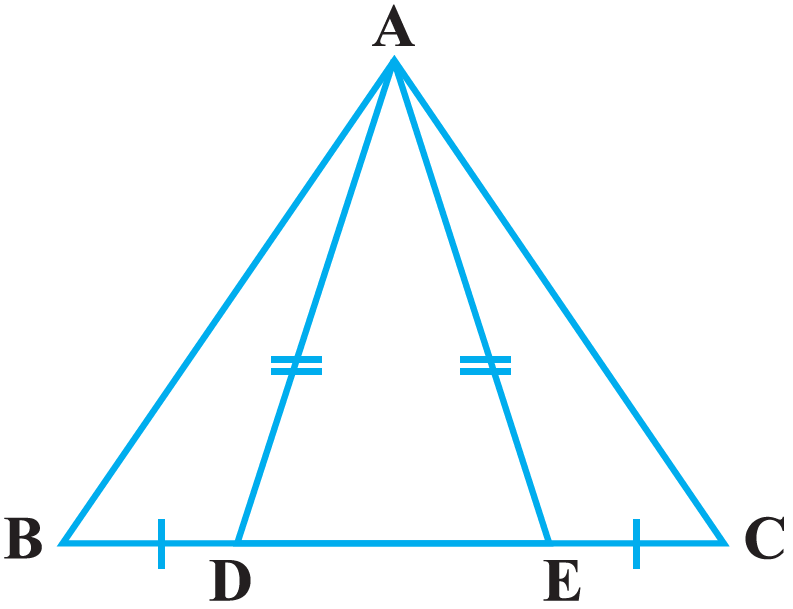
In D and E are points on side BC of a $\triangle\text{ABC}$ such that BD = CE and AD = AE. Show that $\triangle\text{ABC}\cong\triangle\text{ACE}.$
Two lines are respectively perpendicular to two parallel lines. Show that they are parallel to each other.
Rationalise the denominator of the following:
$\frac{4}{2+\sqrt{3}+\sqrt{7}}$
In Fig. AB = AC and DB = DC, find the ratio $\angle\text{ABD}:\angle\text{ACD}.$
P and Q are the mid-points of the opposite sides AB and CD of a parallelogram ABCD. AQ intersects DP at S and BQ intersects CP at R. Show that PRQS is a parallelogram.
A bus stop is barricaded from the remaining part of the road, by using $50$ hollow cones made of recycled card board. Each cone has a base diameter of $40\ cm$ and height $1m.$ If the outer side of each of the cones is to be painted and the cost of painting is $Rs. 12$ per $m^2,$ what will be the cost of painting all these cones? $($Use $\pi=3.14$ and $\sqrt{1.04}=1.02)$
Simplify the following: $(2x - 5y)^3 - (2x + 5y)^3$