MCQ
In triangles $ABC$ and $PQR$, if $\angle\text{A}=\angle\text{R},\angle\text{B}=\angle\text{P}$ and $\text{AB}=\text{RP},$ then which one of the following congruence conditioins applies:
  • A
    $SAS$
  • $ASA$
  • C
    $SSS$
  • D
    $RHS$

Answer

Correct option: B.
$ASA$
From given conditions,
$\angle\text{B}=\angle\text{P}$
$\angle\text{A}=\angle\text{R}$
And the side containing then is also equal
i.e $\text{AB}=\text{PR}$
So ASA property.
Hence, correct option is $(b).$

Need a full question paper?

Generate a complete, print-ready paper with questions like this in minutes — across 16+ boards, with answer keys.
Start Generating Free

Similar questions

If $\text{x}=\big(7+4\sqrt{3}\big)$ then $\Big(\text{x}+\frac{1}{\text{x}}\Big)=?$
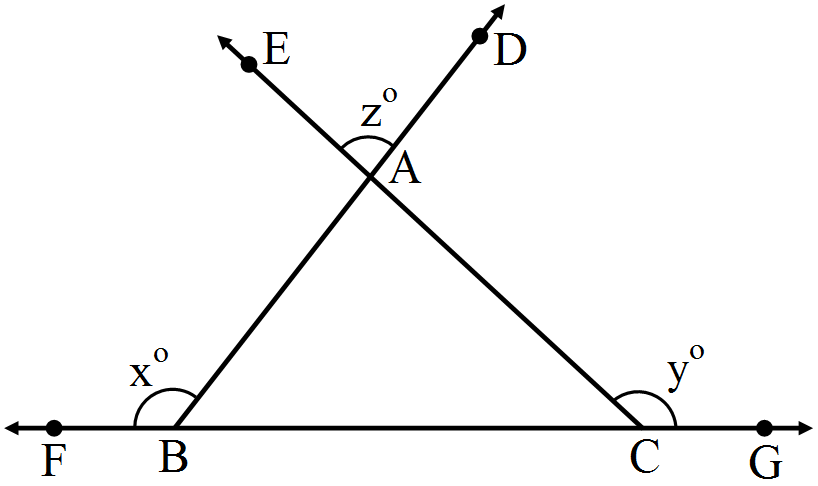
In the given figure, two rays $BD$ and $CE$ intersect at a point A. The side $BC$ of $\triangle\text{ABC}$ have been produced on both sides to points $F$ and $G$ respectively. If $\angle\text{ABF}=\text{x}^\circ,\angle\text{ACG}=\text{y}^\circ$ and $\angle\text{DAE}=\text{z}^\circ$ then $z =?$
If $x+\frac{1}{x}=2$, then $x^3+\frac{1}{x^3}=$
Point $(0, -8)$ lies.
The sides of a parallelogram are $100m$ each and the length of the longest diagonal is $160m.$ The area of a parallelogram is:
Write the correct answer in the following: A grouped frequency table with class intervals of equal sizes using $250-270$ ($270$ not included in this interval) as one of the class interval is constructed for the following data: $268, 220, 368, 258, 242, 310, 272, 342, 310, 290, 300, 320, 319, 304, 402, 318, 406, 292, 354, 278, 210, 240, 330, 316, 406, 215, 258, 236$. The frequency of the class $310-330$ is:
The sides of a triangle are $11\ cm, 15\ cm$ and $16\ cm$. The altitude to the largest side is:
How many linear equations in x and y can be satisfied by x = 1 and y = 2?
If $AB, AC, AD$ and $AE$ are parallel to a line $q$, then the points $A, B, C, D$ and $E$ are:
In each of the questions one question is followed by two statements $I$ and $II$. Choose the correct option.Is quadrilateral $\text{ABCD}$ a parallelogram?
$i$.Diagonals $AC$ and $BD$ bisect each other.
$ii$.Diagonals $AC$ and $BD$ are equal.