Question
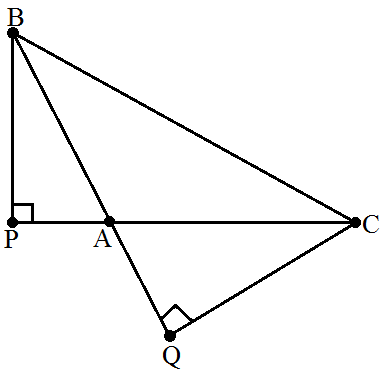
In $\triangle\text{ABC},\ \angle\text{A}$ is obtuse, $\text{PB}\perp\text{AC}$ and $\text{QC}\perp\text{AB}$ Prove that:
$AB × AQ = AC × AP$

Answer


Then, $\triangle\text{APB}\sim\triangle\text{AQC} [$By $AA$ similarity$]$
$\therefore\frac{\text{AP}}{\text{AQ}}=\frac{\text{AB}}{\text{AC}} [$Corresponding parts of similar $\triangle$ are proportional$]$
$⇒ AP × AC = AQ × AB .....(i)$

Need a full question paper?

Generate a complete, print-ready paper with questions like this in minutes — across 16+ boards, with answer keys.

Start Generating Free

Similar questions

Find the area of the sector of a circle having radius $6\ cm$ and of angle $30^\circ .  \big[\text{Take }\pi=3.14\big]$
Thirty women were examined in a hospital by a doctor and the number of heartbeats per minute was recorded and summarized as follows. Find the mean heartbeats per minute for these women, choosing a suitable method.
Number of heartbeats per minute $65-68$ 68-71 $71-74$ $74-77$ $77-80$ $80-83$ $83-86$
Number of women $2$ $4$ $3$ $8$ $7$ $4$ $2$
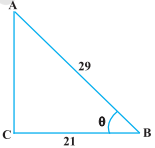
Consider $ \triangle A C B$ right angled at $C$ in which $AB = 29$ units, $BC = 21$ units and $ \angle A B C$= $\theta$. Determine the values of
  1. $ \cos ^2 \theta+\sin ^2 \theta $
  2. $ \cos ^2 \theta-\sin ^2 \theta$
A positive integer is of the form $3q + 1, q$ being a natural number. Can you write its square in any form other than $3m + 1, 3m$ or $3m + 2$ for some integer m$?$ Justify your answer.
The corresponding sides of two similar triangles are in the ratio $2 : 3.$ If the area of the smaller triangle is $48cm^2$, find the area of the larger triangle.
A class teacher has the following absentee record of $40$ students of a class for the whole term. Find the mean number of days a student was absent.
Number of days $0-6$ $6-10$ $10-14$ $14-20$ $20-28$ $28-38$ $38-40$
Number of students $11$ $10$ $7$ $4$ $4$ $3$ $1$
Find the roots of the following equations, if they exist, by applying the quadratic formula:
$ 16 x^2=24 x+1 $
For what value of $k,$ is $-2$ a zero of the polynomial $3x^2+ 4x + 2k?$
In the following, determine whether the given quadratic equation have real roots and if so, find the roots:
$\sqrt{3}\text{x}^2+10\text{x}-8\sqrt{3}=0$
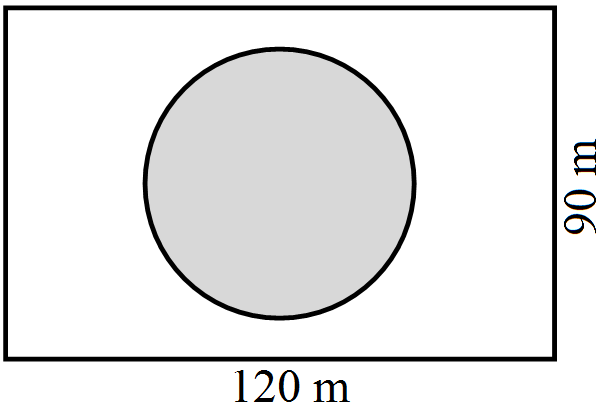
A park is in the form of a rectangle $120m$ by $90m.$ At the centre of the park, there is a circular lawn as shown in the figure. The area of the park excluding the lawn is $2950m^2$ Find the radius of the circular lawn. $\big[\text{Given }\pi = 3.14.\big]$