Question
  1. In what way is diffraction from each slit related to the interference pattern in a double slit experiment?
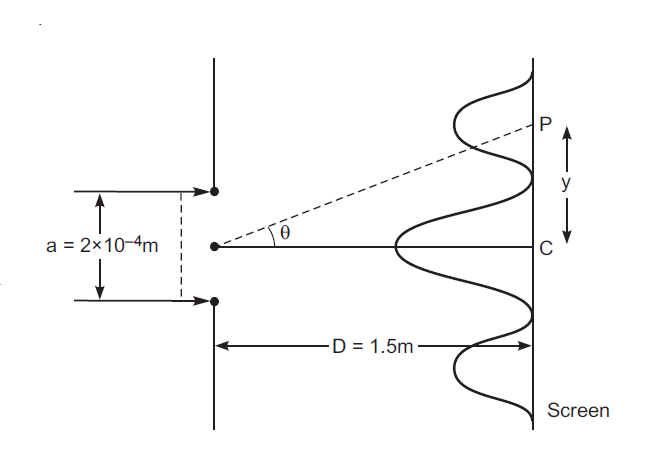
  2. Two wavelengths of sodium light 590 nm and 596 nm are used, in turn, to study the diffraction taking place at a single slit of aperture 2 \times $10^{–4}\ m.$ The distance between the slit and the screen is 1.5 m. Calculate the separation between the positions of the first maxima of the diffraction pattern obtained in the two cases.
Answer

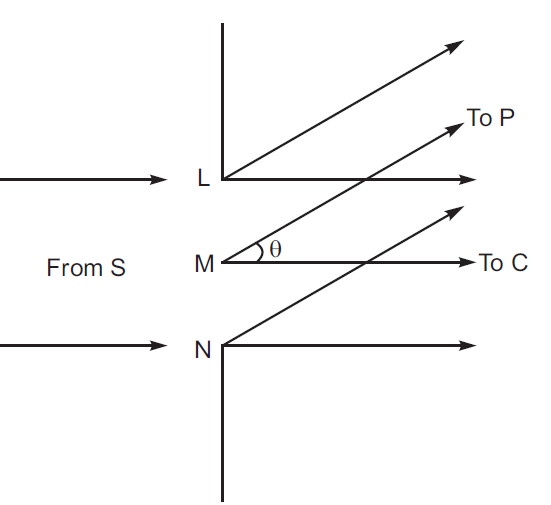
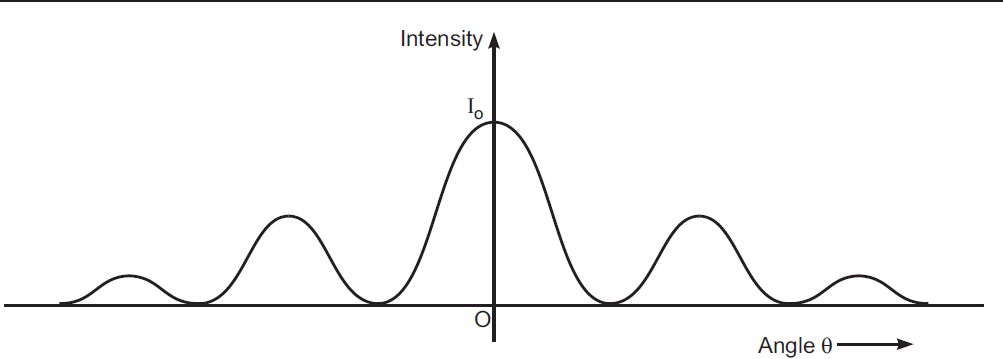
  1. When a plane wavefront of monochromatic light illuminates, the slit LN, each point in the slit LN becomes the source of secondary wavelets. The secondary wavelets originating from different points superpose on each, while travelling towards the point C and point P; at angle$\theta$. However the superposition of the secondary wavelets produces a diffraction pattern of varying intensity, as shown in fig.

  1. For maxima other than central maxima
a.$\theta = \bigg(\text{n} + \frac{1}{2}\bigg)\lambda$
and $\theta = \frac{\text{y}}{\text{D}}$
$\therefore\text{a}.\frac{\text{y}}{\text{D}} = \bigg(\text{n} + \frac{1}{2}\bigg)\lambda$

For light of wavelength $\lambda_{1}$= 590 nm
$2 \times10^{-14}\times\frac{\text{y}_{1}}{1.5} =\big(1+ \frac{1}{2}\big)\times590$
$\text{y}_{1} = \frac{3}{2}\times\frac{590\times10^{-9}\times1.5}{2\times10^{-4}}$
= 6.64 mm
For light of wavelength $\lambda_{2}$=596 mm
$2 \times10^{-4}\times\frac{\text{y}_{2}}{1.5} =\big(1+ \frac{1}{2}\big)\times596\text{nm}$
$\Rightarrow\text{y}_{2} =\frac{3}{2}\times\frac{596\times10^{-9}\times1.5}{2\times10^{-4}}$
= 6.705 mm
Separation between two positions of first maxima
$\Delta\text{y} = \text{y}_{2} - \text{y}_{1}$
= 6.705 – 6.64
= 0.065 mm.

Need a full question paper?

Generate a complete, print-ready paper with questions like this in minutes — across 16+ boards, with answer keys.

Start Generating Free

Similar questions

Electromotive forces of two cells are $E_1$ and $E _2$ and their internal resistances are $r_1$ and $r_2$. Find equivalent electromotive force and equivalent internal resistance on joining them in series.
When you hold a pen and write on your notebook, what kind of force is exerted by you on the pen? By the pen on the notebook? By you on the notebook?
The work function for the following metals is given:
Na: 2.75 eV; K: 2.30 eV; Mo: 4.17 eV; Ni: 5.15 eV. Which of these metals will not give photoelectric emission for a radiation of wavelength 3300 Å from a He-Cd laser placed 1 m away from the photocell? What happens if the laser is brought nearer and placed 50 cm away?
  1. Monochromatic light of wavelength 589 nm is incident from air on a water surface. If $\mu$ for water is 1.33, find the wavelength, frequency and speed of the refracted light.
  2. A double convex lens is made of a glass of refractive index 1.55, with both faces of the same radius of curvature. Find the radius of curvature required, if the focal length is 20 cm.
Explain the principle, construction, working and application of moving coil galvanometer.
What are reflecting type of telescope ? Explain the advantages and disadvantages of reflecting telescopes as compared to refracting telescope and also give the solution.
When can a charge act as a source of electromagnetic wave? How are the directions of electric and magnetic field vectors, in an electromagnetic wave related to each other and to the direction of propagation of the wave?
Which physical quantity, if any, has the same value for waves belonging to the different parts of the electromagnetic spectrum?
  1. When an AC source is connected to an ideal inductor show that the average power supplied by the source over a complete cycle is zero.
  2. A lamp is connected in series with an inductor and an AC source. What happens to the brightness if the lamp when the key is plugged in and an iron rod is inserted inside the inductor? Explain.
Define the terms half-life period and decay constant of a radioactive substance. Write their S.I.units. Establish the relationship between the two.
  1. The potential difference applied across a given resistor is altered so that the heat produced per second increases by a factor of 9. By what factor does the applied potential difference change?
  2. In the figure shown, an ammeter A and a resistor of $4\Omega$ are connected to the terminals of the source. The emf of the source is 12 V having an internal resistance of $2\Omega$. Calculate the voltmeter and ammeter readings.