MCQ
In which complex is the transition metal in zero oxidation state :
  • A
    $[Co(NH_3)_6]Cl_2$
  • B
    $[Fe(H_2O)_6SO_4]$
  • C
    $[Ni(CO)_4]$
  • $[Fe(H_2O)_3](OH)_2$

Answer

Correct option: D.
$[Fe(H_2O)_3](OH)_2$
d
$MnO _4^{-}$, has $Mn ^{+7}, d ^0$ configuration so no $d$ electron.

$Co ^{+3}, d ^6$ configuration.

$Fe ^{-2}, d ^6$ configuration.

$Cr ^{+3}, d ^3$ configuration.

Need a full question paper?

Generate a complete, print-ready paper with questions like this in minutes — across 16+ boards, with answer keys.

Start Generating Free

Similar questions

Correct for physical adsorption is
The $3d-$ metal ions are paramagnetic in nature because
Given below are two statements :
Statement (I): It is impossible to specify simultaneously with arbitrary precision, both the linear momentum and the position of a particle.
Statement (II) : If the uncertainty in the measurement of position and uncertainty in measurement of momentum are equal for an electron, then the uncertainty in the measurement of velocity is $\geq \sqrt{\frac{h}{\pi}} \times \frac{1}{2 m}$.
In the light of the above statements, choose the correct answer from the options given below :
Zinc and mercury do not show variable valency like $d-$ block elements because
A piston filled with $0.04\, mol$ of an ideal gas expands reversibly from $50.0\, mL$ to $375\, mL$ at a constant temperature of $37.0\,^oC.$ As it does so, it absorbs $208\, J$ of heat. The values of $q$ and $w$ for the process will be

$(R = 8.314 \,J/mol\,K)\,(\ln 7.5 =2.01)$
Which of the following is aromatic ?
An element $X$ which occurs in the first short period has an outer electronic structure ${s^2}{p^1}$. What are the formula and acid-base character of its oxides
The solubility of anhydrous $AlCl_3$ and hydrous $AlCl_3$ in diethyl ether are $S_1$ and $S_2$ respectively. Then
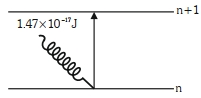
The electron in the $n ^{\text {th }}$ orbit of $Li ^{2+}$ is excited to $(n+1)$ orbit using the radiation of energy $1.47 \times 10^{-17}\,J$ (as shown in the diagram). The value of $n$ is $....$.Given $R_H=2.18 \times 10^{-18}\,J$
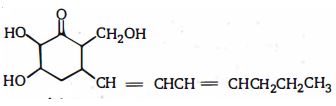
A naturally occurring substance has the constitution shown below. How many may  have this constitution ?