Question
In which configuration will an electric dipole be in (i) permanent and (ii) temporary equilibrium when placed under a uniform electric field?

Answer

(i) When the electric dipole moment $\overrightarrow{ P }$ and the electric field intensity $\vec{E}$ have the same direction.
(ii) When $\overrightarrow{ P }$ and $\overrightarrow{ E }$ are in opposite directions.

Need a full question paper?

Generate a complete, print-ready paper with questions like this in minutes — across 16+ boards, with answer keys.
Start Generating Free

Similar questions

Does the electric potential increase or decrease when moving along the lines of electric force?
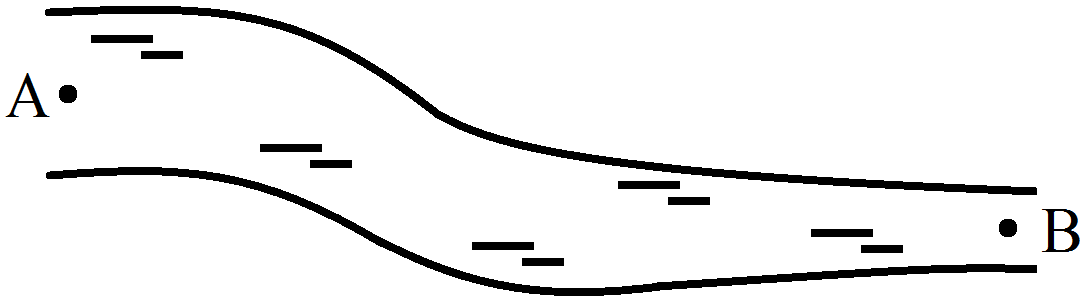
Water flows through a tube shown in The areas of cross$-$section at $A$ and $B$ are $1\ cm^2$ and $0.5\ cm^2$ respectively. The height difference between $A$ and $B$ is $5\ cm$. If the speed of water at $A$ is $10\ cm/s$ find.
  1. The speed at $B$.
  2. The difference in pressures at $A$ and $B$.
The horizontal component of the earth's magnetic field at a place is B and angle of dip is 60°.What is the value of vertical component of earth's magnetic field at equator?
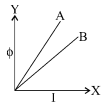
Graph between magnetic flux $\phi$ and electric current $I$ for two inductors $A$ and $B$ is given in the figure. The magnitude of self-inductance will be more for whom?
Image
What is the value of $m$ for the erect (and virtual) image formed by a convex or concave lens?
A block of known mass is suspended from a fixed support through a light spring. Can you find the time period of vertical oscillation only by measuring the extension of the spring, when the block is in equilibrium?
Can you accelerate a car on a frictionless horizontal road by putting more petrol in the engine? Can you stop a car going on a frictionless horizontal road by applying brakes?
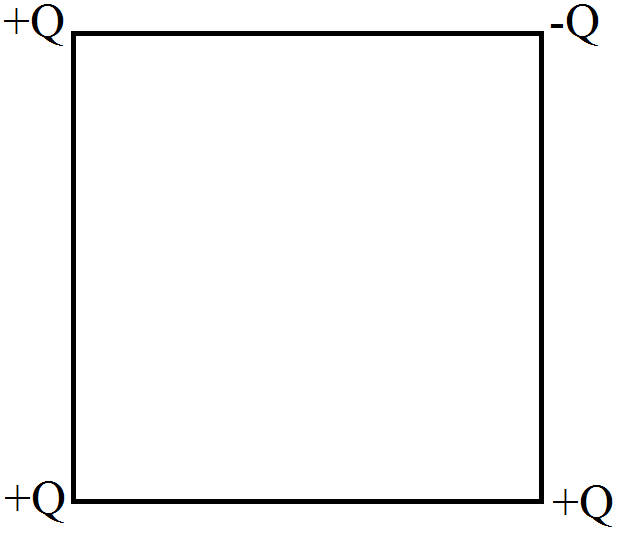
Show diagrammatically the arrangement of four point electric charges of equal magnitude placed at four corners of a square such that the electric field as well as the electric potential at the centre of the square is non-zero.
Electric potential V in any field is constant. What can you say about the electric field E there?
The thermal energy developed in a current$-$carrying resistor is given by $U = i^2\ Rt$ and also by $U = Vit$. Should we say that $U$ is proportional to $i^2$ or $i$?