Question
In which configuration will an electric dipole be in (i) permanent and (ii) temporary equilibrium when placed under a uniform electric field?

Answer

(i) When the electric dipole moment $\overrightarrow{ P }$ and the electric field intensity $\vec{E}$ have the same direction.
(ii) When $\overrightarrow{ P }$ and $\overrightarrow{ E }$ are in opposite directions.

Need a full question paper?

Generate a complete, print-ready paper with questions like this in minutes — across 16+ boards, with answer keys.
Start Generating Free

Similar questions

What physical quantity is the same for X-rays of wavelength $10^{-10} m$, red light of wavelength 6800 Å and radio-waves of wavelength 500 m?
Define magnetic permeability.
As $\text{C}=\Big(\frac{1}{\text{V}}\Big)\text{Q},$ can you say that the capacitance C is proportional to the charge Q?
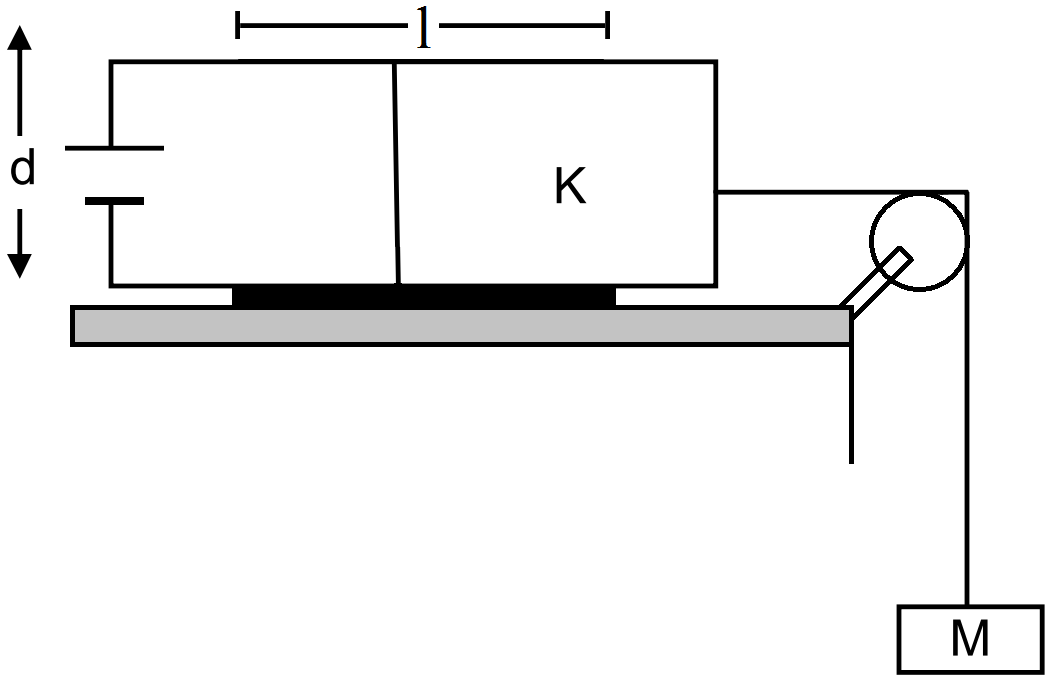
Consider the situation shown in figure. The width of each plate is b. The capacitor plates are rigidly clamped in the laboratory and connected to a battery of emf $\in.$ All surfaces are frictionless. Calculate the value of M for which the dielectric slab will stay in equilibrium.

An air bubble is formed inside water. Does it act as a converging lens or a diverging lens?
What is called equipotential surface?Draw the diagram of equipotential surface due point positive charge.
In a transistor, both emitter and collector regions are of the same nature of doping. Can these regions be interchanged?
Consider a book lying on a table. The weight of the book and the normal force by the table on the book are equal in magnitude and opposite in direction. Is this an example of Newton's third law?
A point source of light moves in a straight line parallel to a plane table. Consider a small portion of the table directly below the line of movement of the source. The illuminance at this portion varies with its distance r from the source as:

  1. $\text{I}\propto\frac{1}{\text{r}}$

  2. $\text{I}\propto\frac{1}{\text{r}^2}$

  3. $\text{I}\propto \frac{1}{\text{r}^3}$

  4. $\text{I}\propto\frac{1}{\text{r}^4}$

  1. Calculate the energy released if 238U emits an $\alpha$-particle.
  2. Calculate the energy to be supplied to 238U it two protons and two neutrons are to be emitted one by one. The atomic masses of 238U, 234Th and 4He are 238.0508u, 234.04363u and 4.00260u respectively.