MCQ
In which conversion, bond length decreases :
  • A
    $N _2 \rightarrow N_2{ }^{+}$
  • B
    $N _2 \rightarrow N_2^{-}$
  • $O _2 \rightarrow O _2^{+}$
  • D
    $O _2 \rightarrow O _2^{-}$

Answer

Correct option: C.
$O _2 \rightarrow O _2^{+}$
(C) $O _2 \rightarrow O _2^{+}$
Bond length $\propto 1 /$ Bond order

Need a full question paper?

Generate a complete, print-ready paper with questions like this in minutes — across 16+ boards, with answer keys.

Start Generating Free

Similar questions

Which of the following compounds will not undergo Friedel Craft's reaction with benzene ?
Which of the following represent correct reactivity order for $SN^1$ as well as $SN^2$
mechanism -
The mechanism of the reaction $2NO_2 + F_2 \to 2NO_2F$ is

$(i)$ $N{O_2}\xrightarrow{{slow}}NO + O$

$(ii)$ ${F_2} + O + NO\xrightarrow{{Fast}}N{O_2}F + F$

$(iii)$ $F + N{O_2}\xrightarrow{{Fast}}N{O_2}F$

Select the correct one

Which metal is present in brass, bronze and German silver
A sample of pure carbon dioxide, irrespective of its source contains $27.27\%$ carbon and $72.73\%$ oxygen. The data support
Barbiturates are hypnotic agents. Veronal is derivative of barbituric acid. It can be synthesis by following sequence, then structure of veronal $(P)$ is :

$CH_2(CO_2 Et)_2 $ $\xrightarrow[Et-I]{EtO^{\circleddash}} \,\,\xrightarrow[Et-I]{EtO^{\circleddash}}
\,\,\overset{Urea}{\rightarrow} $ $(P)$
What would happen when a solution of potassium chromate is treated with an excess of dilute nitric acid
An organic compound $C_xX_YO_z$ on complete combustion provides equivolume of products $CO_2(g)$ and $H_2O(g)$ which is individually double the volume of organic compound taken. In the process volume of oxygen consumed is same as volume of $CO_2$ produced and liberated heat during combustion is $500 \ kcal/mole$ at constant pressure and at $500\ K$. Formula of organic compoun  & $\Delta U$ for reaction will be -
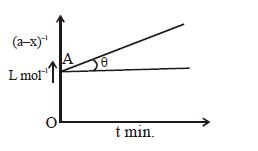
Following is the graph between $(a-x)^{-1}$ and time $t$ for second order reaction if $\theta  = {\tan ^{ - 1}}\left( {\frac{1}{2}} \right)$ ; $OA = 2\,L\,mol^{-1}$ then rate at the start of reation will be $ [$ in $L\, mol^{-1}\,min^{-1}]$
When chlorine water is exposed to sunlight, ${O_2}$ is liberated. Hence