Question
In which frequency range, space waves are normally propagated
|
(a) HF |
(b) VHF |
(c) UHF |
(d) SHF |
In which frequency range, space waves are normally propagated
|
(a) HF |
(b) VHF |
(c) UHF |
(d) SHF |
(c) UHF
Generate a complete, print-ready paper with questions like this in minutes — across 16+ boards, with answer keys.
Out of the following statements which is not correct
|
(a) When unpolarised light passes through a Nicol's prism, the emergent light is elliptically polarised |
|
(b) Nicol's prism works on the principle of double refraction and total internal reflection |
|
(c) Nicol's prism can be used to produce and analyse polarised light |
|
(d) Calcite and Quartz are both doubly refracting crystals |
A truth table is given below. Which of the following has this type of truth table
|
A |
0 |
1 |
0 |
1 |
|
B |
0 |
0 |
1 |
1 |
|
y |
1 |
0 |
0 |
0 |
|
(a) XOR gate |
(b) NOR gate |
(c) AND gate |
(d) OR gate |
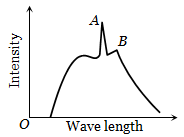
The figure represents the observed intensity of X-rays emitted by an X-ray tube as a function of wavelength. The sharp peaks A and B denote
|
(a) Band spectrum |
(b) Continuous spectrum |
|
(c) Characteristic radiations |
(d) White radiations |
$0^\circ$
$45^\circ$
$90^\circ$
$\cos^{-1}\Big(\frac{1}{\sqrt{3}}\Big)$
A double convex thin lens made of glass (refractive index μ = 1.5) has both radii of curvature of magnitude 20 cm. Incident light rays parallel to the axis of the lens will converge at a distance L such that
|
(a) L = 20 cm |
(b) L = 10 cm |
(c) L = 40 cm |
(d) L = 20 / 3 cm |