Question
In which of the following decays the element does not change?

Answer

  1. $\gamma-\text{decay}$
Explanation:
In alpha particle decay, the unstable nucleus emits an alpha particle reducing its proton number Z by 4 and neutron number N by 2 such that the element gets changed.
$\text{ }^{\text{A}}_{\text{Z}}\text{X}\rightarrow\text{ }^{\text{A}-4}_{\text{Z}-2}\text{Y}+\text{ }^4_2\text{He}$
During $\beta^--\text{decay},$ a neutron is converted to a proton​, an electron and an antineutrino, i.e. an active nucleus gets converted to one of its isobars and hence the element gets changed.
$\text{ }^{\text{A}}_{\text{Z}}\text{X}\rightarrow\text{ }^{\text{A}}_{\text{Z}+1}\text{Y}+\text{e}+\bar{\text{v}}$
During $\beta^+-\text{decay},$ a proton in the nucleus is converted to a neutron​, a positron and a neutrino in order to maintain the stability of the nucleus, i.e. an active nucleus gets converted to one of its isobars and hence the element gets changed.
$\text{ }^{\text{A}}_{\text{Z}}\text{X}\rightarrow\text{ }^{\text{A}}_{\text{Z}-1}\text{Y}+\beta^++\text{v}$
When a nucleus is in higher excited state or has excess of energy, it comes to the ground state in order to become stable and release energy in the form of electromagnetic radiation called gamma ray. Hence, the element in gamma decay doesn't change.

Need a full question paper?

Generate a complete, print-ready paper with questions like this in minutes — across 16+ boards, with answer keys.
Start Generating Free

Similar questions

Assertion   :   The permeability of a ferromagnetic material is independent of the magnetic field.
Reason       : Permeability of a material is a constant quantity.(a) If both assertion and reason are true and the reason is the correct explanation of the assertion.(b) If both assertion and reason are true but reason is not the correct explanation of the assertion.(c) If assertion is true but reason is false.(d) If the assertion and reason both are false.


Sound waves in air cannot be polarized because:
The work done by all the forces (external and internal) on a system equals the change in:
  1. Total energy.
  2. Kinetic energy.
  3. Potential energy.
  4. None of these.
A moving coil sensitive galvanometer gives at once much more deflection. To control its speed of deflection(a) A high resistance is to be connected across its terminals(b) A magnet should be placed near the coil(c) A small copper wire should be connected across its terminals(d) The body of galvanometer should be earthed


At a certain place a magnet makes $30$ oscillations per minute. At another place where the magnetic field is double, its time period will be
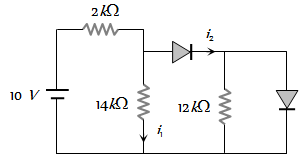
In the following circuit find $I_1$ and $I_2$
The concept of displacement current was introduced by _________.
The characteristic impedance of a coaxial cable is of the order of(a) 50 W  (b) 200 W(c) 270 W(d) None of these
       
A current of 2.0 ampere passes through a cell of e.m.f. 1.5 volts having internal resistance of 0.15 ohm.  The potential difference measured, in volts, across both the ends of the cell will be(a) 1.35(b) 1.50(c) 1.00(d) 1.20
       
If the energy of a photon corresponding to a wavelength of $6000 \mathring A$  is $3.32 \times 10^{-19} J,$ the photon energy for a wavelength of $4000 \mathring A$ will be