MCQ
In which of the following process entropy do not increases?
  • Crystallisation of sugar in solution
  • B
    Vaporisation of camphor
  • C
    Formation of mixture of gases
  • D
    All of the above

Answer

Correct option: A.
Crystallisation of sugar in solution
A

Need a full question paper?

Generate a complete, print-ready paper with questions like this in minutes — across 16+ boards, with answer keys.
Start Generating Free

Similar questions

The correct order regarding the electronegativity of hybrid orbitals of carbon is
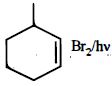
The major product of the following reaction is
What is the mass of the solvent present in $200g$ of $25\%\ (w/ W) $ calcium hydroxide solution?
$300\, ml$ of deci-molar solution of ${Ba(OH)_2}_(aq)$ was titrated with $100\, ml$ of $0.2M\, HCl_(aq)$ solution. The final solution had to be titrated with $V\,\,ml$ of semi-molar ${H_2SO_4}_(aq)$ solution for end-point. Correct option is $V=.......ml$
One energy difference between the states $n = 2$ and $n = 3$ is $E\ eV$ , in hydrogen atom. The ionisation potential of $H$ atom is ............. $\mathrm{E}$
When hydrochloric acid is added to cobalt nitrate solution at room temperature, the following reaction takes place and the reaction mixture becomes blue. On cooling the mixture it becomes pink. On the basis of this information mark the correct answer.
$[\text{Co(H}_2\text{O})_6]^{3+}\text{(aq)}+4\text{Cl}^-\text{(aq)}\rightleftharpoons[\text{CoCl}_4]^{2-}\text{(aq)}+6\text{H}_2\text{O (l)}\\ \ \ \ \ \ \ \ ^\text{(pink)} \ \ \ \ \ \ \ \ \ \ \ \ \ \ \ \ \ \ \ \ \ \ \ \ \ \ \ \ \ \ \ \ \ \ \ \ \ \ \ \ \ \ \ \ \ \ ^\text{(blue)}$
Percentage loss in mass on heating mixture of $Na_2CO_3$ & $CaCO_3$ containing equal mass of the two components will be ............. $\%$
Bond dissociation enthalpy of $H_2, Cl_2$ and $HCl$ are $434, 242$ and $431\ kJ\, mol^{-1}$ respectively. Enthalpy of formation of $HCl$ is ............... $\mathrm{kJ \,mol}^{-1}$
Match List$-I$ with List$-II.$

List$-I$ List$-II$
$(a)$ $Ne _{2}$ $(i)$ $1$
$(b)$ $N _{2}$ $(ii)$ $2$
$(c)$ $F _{2}$ $(iii)$ $0$
$(d)$ $O _{2}$ $(iv)$ $3$

Choose the correct answer from the options given below:

For which reaction from the following, $\Delta S$ will be maximum