MCQ
In which of the following the final image is erect?
  • Simple microscope
  • B
    Compound microscope
  • C
    Astronomical telescope
  • D
    None of these

Answer

Correct option: A.
Simple microscope

Only in simple microscope the image formed is erect, while it is inverted in compound microscope and astronomical telescope.

Need a full question paper?

Generate a complete, print-ready paper with questions like this in minutes — across 16+ boards, with answer keys.
Start Generating Free

Similar questions

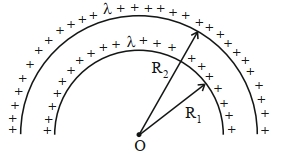
The electric potential at the centre of two concentric half rings of radii $R_1$ and $R_2$, having same linear charge density $\lambda$ is
Assertion : Self-inductance is called the inertia of electricity.
Reason : Self-inductance is the phenomenon, according to which an opposing induced e.m.f. is produced in a coil as a result of change in current or magnetic flux linked in the coil.
If $\vec{E}$ and $\vec{K}$ represent electric field and propagation vectors of the EM waves in vacuum, then magnetic field vector is given by : $(\omega-$ angular frequency) :
A double slit experiment is performed with light of wavelength 500 nm. A thin film of thickness 2 mm and refractive index 1.5 is introduced in the path of the upper beam. The location of the central maximum will
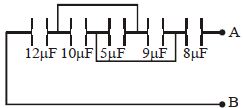
Five capacitors together with their capacitances are shown in the adjoining figure. The potential difference between the points $A$ and $B$ is $60\, volt.$ The equivalent capacitance between the point $A$ and $B$ and charge on capacitor $5\,\mu F$ will be respectively :-
A sodium atom is in one of the states labeled 'Lowest excited levels'. It remains in that state for an average time of $10^{-8}\, sec$, before it makes a transition back to a ground state. What is the uncertainty in energy of that excited state
In a cassette player, material used for coating magnetic tapes is:
The modulation index of an $FM$ carrier having a carrier swing of $200\, kHz$ and a modulating signal $10\, kHz$ is
The focal length of a convex lens depends upon
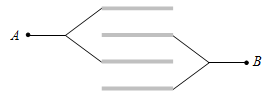
Four plates of the same area of cross-section are joined as shown in the figure. The distance between each plate is d. The equivalent capacity across A and B will be