MCQ
In which reaction last product is $Ph -C \equiv CH$ ?
  • A
    $\begin{matrix}
       \,\,\,\,\,\,Br  \\
       \,\,\,|  \\
       {{C}_{6}}{{H}_{5}}-C-C{{H}_{3}}  \\
       \,\,\,|  \\
       \,\,\,\,\,Br  \\
    \end{matrix}\xrightarrow[Mineral\,\,oil,heat]{2NaN{{H}_{2}}}\xrightarrow{N{{H}_{4}}Cl}$
  • B
    ${{C}_{6}}{{H}_{5}}CH=C{{H}_{2}}\xrightarrow[CC{{l}_{4}}]{B{{r}_{2}}}\xrightarrow[Mineral\,\,oil,heat]{3NaN{{H}_{2}}}\xrightarrow{N{{H}_{4}}Cl}$
  • C
    $\begin{array}{*{20}{c}}
      {\,\,\,\,O} \\ 
      {\,\,\,||} \\ 
      {{C_6}{H_5} - C - C{H_3}} 
    \end{array}\xrightarrow{{PC{l_5}}}\xrightarrow[{\min eral\,oil,\,heat}]{{3NaN{H_2}}}\xrightarrow{{N{H_4}Cl}}$
  • All

Answer

Correct option: D.
All
d
$(d)$

Need a full question paper?

Generate a complete, print-ready paper with questions like this in minutes — across 16+ boards, with answer keys.

Start Generating Free

Similar questions

In which of the following species the bonds are non-directional?
The most abundant elements by mass in the body of a healthy human adult are :

Oxygen $(61.4\%);$ Carbon $(22.9\%),$ Hydrogen $(10.0\%);$ and Nitrogen $(2.6\%).$ The weight which a $75\, kg$ person would gain if all $^1H$ atoms are replaced by $^2H$ atoms is ....... $kg$

Assertion : The $pK_a$ of acetic acid is lower than that of phenol.
Reason : Phenoxide ion is more resonance stabilised.
Identify the product for the following reaction

$\begin{array}{*{20}{c}}
O\\
{||}\\
{C{H_3} - C - C{H_3}}
\end{array}$ $ + \begin{array}{*{20}{c}}
{C{H_2}OH}\\
{\,\,\,\,|\,\,\,\,\,\,\,\,\,\,\,\,\,\,\,\,\,\,\,\,\,\,}\\
{C{H_2}OH}
\end{array}$ $\overset{HCl}{\longleftrightarrow}$ ?

Reduction potential of ions are given below:

$ClO_4^{-}$  $IO_4^{-}$ $BrO_4^{-}$ 
$E^{\circ}=1.19 V$  $E^{\circ}=1.65 V$ $E^{\circ}=1.74 V$

 The correct order of their oxidising power is:

Regular use of the following fertilizers increases the acidity of soil ?
The following has zero valency
Combustion of $1$ mole of benzene is expressed at

$\mathrm{C}_6 \mathrm{H}_6(1)+\frac{15}{2} \mathrm{O}_2(\mathrm{~g}) \rightarrow \mathrm{CO}_2(\mathrm{~g})+3 \mathrm{H}_2 \mathrm{O}(1) \text {. }$

The standard enthalpy of combustion of $2 \mathrm{~mol}$ of benzene is - ' $x$ ' $k J$.

$\mathrm{x}=$. . . . . . . . . .

$(1)$ standard Enthalpy of formation of $1 \mathrm{~mol}$ of $\mathrm{C}_6 \mathrm{H}_6(1)$, for the reaction $6 \mathrm{C}$ (graphite) $+3 \mathrm{H}_2(\mathrm{~g}) \rightarrow \mathrm{C}_6 \mathrm{H}_n(1)$ is $48.5 \mathrm{~kJ} \mathrm{~mol}^{-1}$.

$(2)$ Standard Enthalpy of formation of $1 \mathrm{~mol}$ of $\mathrm{CO}_2(\mathrm{~g})$, for the reaction $\mathrm{C}$ (graphite) $+\mathrm{O}_{2(\mathrm{~g})} \rightarrow \mathrm{CO}_2(\mathrm{~g})$ is $-393.5 \mathrm{~kJ} \mathrm{~mol}^{-1}$.

$(3)$ Standard and Enthalpy of formation of $1 \mathrm{~mol}$ of $\mathrm{H}_2 \mathrm{O}(1)$, for the reaction $\mathrm{H}_2(\mathrm{~g})+\frac{1}{2} \mathrm{O}_2(\mathrm{~g}) \rightarrow \mathrm{H}_2 \mathrm{O}(1)$ is $-286 \mathrm{~kJ} \mathrm{~mol}^{-1}$.

Which of the following pair of orbitals, the probability of finding the electron is zero in $XY$ plane?
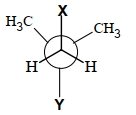
In the Newman projection for $2,2$-dimethylbutane $Image$ ${X}$ and ${Y}$ can respectively be

$(A)$ $\mathrm{H}$ and $\mathrm{H}$

$(B)$ $\mathrm{H}$ and $\mathrm{C}_2 \mathrm{H}_5$

$(C)$ $\mathrm{C}_2 \mathrm{H}_5$ and $\mathrm{H}$

$(D)$ $\mathrm{CH}_3$ and $\mathrm{CH}_3$