MCQ
In which segment of the nephron, reabsorption is minimum?
- AProximal convoluted tubule $(PCT)$
- BDistal convoluted tubule $(DCT)$
- ✓Loop of Henle
- DBoth $(a)$ and $(b)$
Generate a complete, print-ready paper with questions like this in minutes — across 16+ boards, with answer keys.
$X-Y-Z$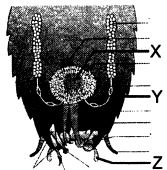
$\begin{array}{|l|l|} \hline Column\;-I & Column\;-II \\ \hline 1.\;Metaphase & p.\;Chromosomal\;material\;condensed \\ \hline 2.\;Prophase & q.\;Nucleolus\;reform \\ \hline 3.\;Anaphase & r.\;Spindle\;fibre\;attach\;to\;kinetochores \\ \hline 4.\;Telophase & s.\;Chromatids\;move\;to\;opposite\;poles \\ \hline \end{array}$
$(i)$ Most of them are fresh water organisms found in standing water.
$(ii)$ They have a protein rich layer (called pellicle) which makes their body flexible.
$(iii)$ They have two flagella, a short and a long one.
$(iv)$ Though they are photosynthetic in the presence of sunlight, but in the absence of sunlight they behave like heterotrophs by predating on other smaller organisms. Identify the correct group on the basis of these characters.
$(i)$ Ascidia' $(ii)$ Cockroach
$(iii)$ Earthworm $(iv)$ Prawn
$(v)$ Silver fish $(vi)$ Snail
$(vii)$ Squid