MCQ
In Williamson's synthesis, ethoxyethane is prepared by
  • A
    Passing ethanol over heated alumina
  • Sodium ethoxide with ethyl cloride
  • C
    Ethyl alcohol with sulphuric acid
  • D
    Ethyl iodide and dry silver oxide

Answer

Correct option: B.
Sodium ethoxide with ethyl cloride
b
(b) Williamson’s synthesis -

$C{H_3} - C{H_2} - ONa + Cl - C{H_2} - C{H_3} \to $
$C{H_3} - C{H_2} - O - C{H_2} - C{H_3}$

Need a full question paper?

Generate a complete, print-ready paper with questions like this in minutes — across 16+ boards, with answer keys.
Start Generating Free

Similar questions

Which of the following aqueous molal solution have highest freezing point,
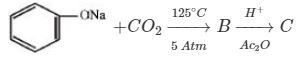
Sodium phenoxide when heated with $CO_2$ under pressure at $125\,^o C$ yields a product which on acetylation produces $C.$  The major product $C$ would be
Of the following $0.10\, m$ aqueous solutions, which one will exhibit the largest freezing point depression ?
In the presence of a dilute base ${C_6}{H_5}CHO$ and $C{H_3}CHO$ react together to give a product. The product is
Atomic number of three elements A, B, and C are respectively,
Pm (Z = 61), Sm (Z = 62), Eu (Z = 63).
Which one has a maximum atomic radius?
Amongst $TiF_6^{2 - },CoF_6^{3 - },C{u_2}C{l_2}$ and $NiCl_4^{2 - }$ (Atomic number $Ti = 22,$ $Co = 27,$ $Cu = 29,$ $Ni = 28$). The colourless species are
Given below are two statements: one is labelled as Assertion $(A)$ and the other is labelled as Reason $(R)$.

Assertion $(A)$ : Haloalkanes react with $\mathrm{KCN}$ to form alkyl cyanides as a main product while with $\mathrm{AgCN}$ form isocyanide as the main product.

Reason $(R)$ : $\mathrm{KCN}$ and $\mathrm{AgCN}$ both are highly ionic compounds.

In the light of the above statement, choose the most appropriate answer from the options given below:

${C_2}{H_5}Br\,\xrightarrow{{AgCN}}X\xrightarrow[{Zn - Hg/HCl}]{{{\text{Reduction}}}}Y,$ Here $Y$ is
The correct order of spin only magnetic moment (in $BM$ ) for $M n^{2+}, C r^{2+}$ and $T i^{2+}$ ions is


Which of the following react with benzoic acid to form ethyl benzoate