Question
In $X-$ ray experiment $K_{\alpha}$, $K_{\beta}$ denotes

Answer

(a)


Need a full question paper?

Generate a complete, print-ready paper with questions like this in minutes — across 16+ boards, with answer keys.
Start Generating Free

Similar questions

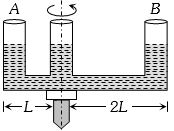
A given shaped glass tube having uniform cross section is filled with water and is mounted on a rotatable shaft as shown in figure. If the tube is rotated with a constant angular velocity $\omega $then
A $150\, m$ long train is moving to north at a speed of $10 \,m/s$. A parrot flying towards south with a speed of $5\, m/s$ crosses the train. The time taken by the parrot the cross to train would be........$s$
Two springs have spring constants ${K_A}$ and ${K_B}$ and ${K_A} > {K_B}$. The work required to stretch them by same extension will be
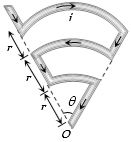
Find magnetic field at $O$
A man stands in front of a hillock and fires a gun. He hears an echo after $1.5\, sec$. The distance of the hillock from the man is ...... $m$ (velocity of sound in air is $330\, m/s$)
The magnetic field at the origin due to a current element $i\,\overrightarrow {dl} $ placed at position $\vec r$ is

$(i)\,\,\left( {\frac{{{\mu _0}i}}{{4\pi }}} \right)\left( {\frac{{d\vec l\, \times \,\vec r}}{{{r^3}}}} \right)$

$(ii)\,\, - \left( {\frac{{{\mu _0}i}}{{4\pi }}} \right)\left( {\frac{{d\vec l\, \times \,\vec r}}{{{r^3}}}} \right)$

$(iii)\,\left( {\frac{{{\mu _0}i}}{{4\pi }}} \right)\left( {\frac{{\,\vec r \times d\vec l}}{{{r^3}}}} \right)$
$(iv)\, - \left( {\frac{{{\mu _0}i}}{{4\pi }}} \right)\left( {\frac{{\,\vec r \times d\vec l}}{{{r^3}}}} \right)$

Two coils $P$ and $Q$ are separated by some distance. When a current of $3\, A$ flows through coil $P$ a magnetic flux of $10^{-3}\, Wb$ passes through $Q$. No current is passed through $Q$. When no current passes through $P$ and a current of $2\, A$ passes through $Q$, the flux through $P$ is
Two bodies of masses $m$ and $4\,m$ are placed at a distance $r$. The gravitational potential at a point on the line joining them where the gravitational field is zero is
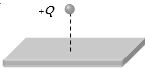
A charge $Q$ is fixed at a distance $d$ in front of an infinite metal plate. The lines of force are represented by
A free electron of $2.6\, {eV}$ energy collides with a ${H}^{+}$ ion. This results in the formation of a hydrogen atom in the first excited state and a photon is released. Find the frequency of the emitted photon. $\left({h}=6.6 \times 10^{-34}\, {J} {s}\right)$