- ✓$\frac{3}{4}$
- B$\frac{1}{\sqrt{2}}$
- C$\sqrt{3} / 2$
- D$\frac{1}{2}$
Generate a complete, print-ready paper with questions like this in minutes — across 16+ boards, with answer keys.
A coil of wire having finite inductance and resistance has a conducting ring placed coaxially within it. The coil is connected to a battery at time t = 0, so that a time-dependent current
starts flowing through the coil. If
is the current induced in the ring. and B(t) is the magnetic field at the axis of the coil due to
, then as a function of time (t > 0), the product I2 (t) B(t)
|
(a) Increases with time |
(b) Decreases with time |
|
(c) Does not vary with time |
(d) Passes through a maximum |
$1:1$
$1:2$
$\pi:2$
$2:\pi$

In a transformer, the coefficient of mutual inductance between the primary and the secondary coil is 0.2 henry. When the current changes by 5 ampere/second in the primary, the induced e.m.f. in the secondary will be
|
(a) 5 V |
(b) 1 V |
(c) 25 V |
(d) 10 V |
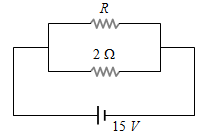
If in the circuit, power dissipation is 150 W, then R is

|
(a) 2 W |
(b) 6 W |
(c) 5 W |
(d) 4 W |
If the de-Broglie wavelengths for a proton and for a α - particle are equal, then the ratio of their velocities will be
|
(a) 4 : 1 |
(b) 2 : 1 |
(c) 1 : 2 |
(d) 1 : 4 |