Question
In Young's double slit experiment, if monochromatic light is replaced by white light(a) All bright fringes become white(b) All bright fringes have colours between violet and red(c) Only the central fringe is white, all other fringes are coloured(d) No fringes are observed


Answer

(c) Only the central fringe is white, all other fringes are coloured

Need a full question paper?

Generate a complete, print-ready paper with questions like this in minutes — across 16+ boards, with answer keys.

Start Generating Free

Similar questions

A metal cube is placed in an empty vessel. When water is filled in the vessel so that the cube is completely immersed in the water, the force on the bottom of the vessel in contact with the cube.
  1. Will increase.
  2. Will decrease.
  3. Will remain the same.
  4. Will become zero.
Gauss’s law should be invalid if(a) There were magnetic monopoles(b) The inverse square law were not exactly true(c) The velocity of light were not a universal constant(d) None of these


The phase difference between alternating emf and current in a purely capacitive circuit will be.
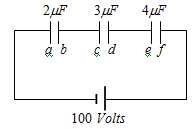
Three capacitors are connected to $D.C.$  source of $100$ volts  shown in the adjoining figure. If the charge accumulated on plates of $C_1,C_2$ and $C_3$  are $q_{a}, q_{b}, q_{c}, q_{d}, q_{e}$ and  $q_{f}$  respectively, then
+ 2C and +6C two charges are repelling each other with a force of 12N.  If each charge is given  -2C of charge, then the value of the force will be(a) 4N  (Attractive)(b) 4N  (Repulsive)(c) 8N (Repulsive)(d) Zero
       
When light propagates in vacuum there is an electric field and a magnetic field. These fields.
If $T$ is the half life of a radioactive material, then the fraction that would remain after a time $\frac{T}{2}$ is
An object is placed at a distance u from a simple microscope of focal length f. The angular magnification obtained depends:
  1. On f but not on u.
  2. On u but not on f.
  3. On f as well as u.
  4. Neither on f nor on u.
A point source of light is placed in front of a plane mirror:
  1. All the reflected rays meet at a point when produced backward.
  2. Only the reflected rays close to the normal meet at a point when produced backward.
  3. Only the reflected rays making a small angle with the mirror, meet at a point when produced backward.
  4. Light of different colours make different images.
A point source of light is placed in front of a plane mirror: