Question
In Young's double slit experiment, the distance between sources is 1 mm and distance between the screen and source is 1 m. If the fringe width on the screen is 0.06 cm, then λ =    (a) 6000 Å(b) 4000 Å(c) 1200 Å(d) 2400 Å
       

Answer

(a) 6000 Å

Need a full question paper?

Generate a complete, print-ready paper with questions like this in minutes — across 16+ boards, with answer keys.
Start Generating Free

Similar questions

A common emitter amplifier is designed with NPN transistor (a = 0.99). The input impedance is 1 KW and load is 10 KW. The voltage gain will be(a) 9.9(b) 99(c) 990(d) 9900
       
Zener-diode is used in:
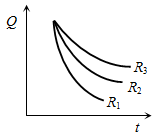
Three identical capacitors are given a charge $Q$ each and they are then allowed to discharge through resistance $R_1, R_2$ and $R_3.$ Their charges, as a function of time shown in the graph below. The smallest of the three resistance is
Which of the following particles will have minimum frequency of revolution when projected with the same velocity perpendicular to a magnetic field?
The chemical equivalent of silver is 108. If the current in a silver voltameter is 2 Amp., the time required to deposit 27 grams of silver will be(a) 8.57 hrs(b) 6.70 hrs(c) 3.35 hrs(d) 12.50 hrs
       
An EM wave of intensity I falls on a surface kept in vacuum and exerts radiation pressure p on it. Which of the following are true?
A light bulb is placed between two plane mirrors inclined at an angle of 60°. The number of images formed are (a) 6(b) 2(c) 5  (d) 4
       
Plane polarised light is passed through a polaroid. On viewing through the polaroid we find that when the polariod is given one complete rotation about the direction of the light, one of the following is observed (a) The intensity of light gradually decreases to zero and remains at zero (b) The intensity of light gradually increases to a maximum and remains at maximum(c) There is no change in intensity (d) The intensity of light is twice maximum and twice zero


When the convergent nature of a convex lens will be less as compared with air(a) In water (b) In oil(c) In both (a) and (b) (d) None of these
       
Three equal charges are placed on the three corners of a square. If the force between $q_{1}$ and $q_2$ is $F_{12}$ and that between $q_1$ and $q_3$ is $F _{13}$, the ratio of magnitudes $\frac{F_{12}}{F_{18}}$ is