MCQ
In Young's double slit experiment, the intensity at a point where path difference is $\frac{\lambda}{6}$ is $l$. If $l_0$ denotes the maximum intensity, $\frac{l}{l_0}$.
  • A
    $\frac{1}{\sqrt{2}}$
  • B
    $\frac{\sqrt{3}}{2}$
  • C
    $\frac{1}{2}$
  • $\frac{3}{4}$

Answer

Correct option: D.
$\frac{3}{4}$
d
(d)

Where, $\Delta x=\frac{\lambda}{6}$

$\Delta \phi=\frac{2 \pi}{\lambda} \Delta x$

$\therefore \Delta \phi=\frac{\pi}{3}$

$I=I_0 \cos ^2\left(\frac{\Delta \phi}{2}\right)$

$I=I_0 \cos ^2\left(\frac{\pi}{6}\right)$

or $I=I_0 \times \frac{3}{4}$

$\therefore \quad \frac{I}{I_0}=\frac{3}{4}$

Need a full question paper?

Generate a complete, print-ready paper with questions like this in minutes — across 16+ boards, with answer keys.

Start Generating Free

Similar questions

Which of the following quantities remain constant in a planetary motion (consider elliptical orbits) as seen from the sun?
The current in a conductor varies with time t as $I=2 t+3 t^2$ where I is in ampere and t in seconds. Electric charge flowing through a section of the conductor during t = 2 sec to t = 3 sec is
 In a $YDSE$ bi-choromatic light of wavelength $400\, nm$ and $560\, nm$ are used. The distance betweenmthe slits is $0.1\, mm$ and the distance between the plane of the slits and the screen is $1\,m$. The minimum distance between two successive regions of complete darkness is.......$mm$
Power factor of an ideal choke coil (i.e., $R=0$ ) is
In a semiconductor diode, the barrier potential offers opposition to:
A cell of internal resistance 3 ohm and emf 10 volt is connected to a uniform wire of length 500 cm and resistance 3 ohm. The potential gradient in the wire is
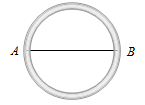
The resistance of a wire is $10^{-6}\Omega$ per metre. It is bend in the form of a circle of diameter 2 m. A wire of the same material is connected across its diameter. The total resistance across its diameter AB will be

Tungsten has work function $4.8\ eV$. We wish to use tungsten as photo$-$cathode with a $600\ nm$ wavelength. What shall we do?
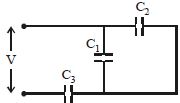
Three capacitors $C_1,\,C_2$ and $C_3$ are connected as shown in the figure to a battery of $V\,volt$. If the capacitor $C_3$ breaks down electrically the change in total charge on the combination of capacitors is
Unpolarized light falls on two polarizing sheets placed one after another. What should be the angle between pass axis of the sheets so that final transmitted light have one fourth intensity of incident light?