Question
In Young's double slit experiment, the phase difference between the light waves reaching third bright fringe from the central fringe will be (λ =6000 Å )(a) Zero(b) 2π(c) 4 π(d) 6 π
       

Answer

(d) 6 π

Need a full question paper?

Generate a complete, print-ready paper with questions like this in minutes — across 16+ boards, with answer keys.
Start Generating Free

Similar questions

How does the potential difference change with the effect of the dielectric when the battery remains connected across the capacitor?
What is immaterial for an electric fuse wire (a) Specific resistance of the wire(b) Radius of the wire(c) Length of the wire(d) Current flowing through the wire
   
   
In a Young’s double slit experiment, the slit separation is 1 mm and the screen is 1 m from the slit. For a monochromatic light of wavelength 500 nm, the distance of 3rd minima from the central maxima is (a) 0.50 mm(b) 1.25 mm(c) 1.50 mm(d) 1.75 mm
       
Two bodies $A$ and $B$ having equal surface areas are maintained at temperatures $10^\circ C$ and $20^\circ C$. The thermal radiation emitted in a given time by $A$ and $B$ are in the ratio:
A beam of ions with velocity $2 \times 10^6\ m/s$  enters normally into a uniform magnetic field of $4 \times 10^{-2}$. tesla If the specific charge of the ion is $5 \times 10^7 C/kg,$ then the radius of the circular path described will be
Which of the following is wrong statement about binding energy?
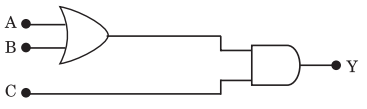
In combination of gates shown in adjacent figure, to get output Y = 1 which of the following is correct?
Image
Two unlike charges attract each other with a force of 10N. If the distance between them is doubled, the force between them is:
The north pole of a magnet is brought near a metallic ring. The direction of the induced current in the ring will be(a) Clockwise(b) Anticlockwise(c) Towards north(d) Towards south
       
A charge $q1$​ exerts a force of $45N$ on a charge of $q_{2 }​= 10^{-5}C$ located at a point $0.2m$ from $q_{1​}.$ The magnitude of $q_{1​ }$ is: