MCQ
In Young’s doubled slit experiment, the separation between the slit and the screen increases. The fringe width
  • Increases
  • B
    Decreases
  • C
    Remains unchanged
  • D
    None of these

Answer

Correct option: A.
Increases
a
(a)$\beta = \frac{{\lambda D}}{d}$

Need a full question paper?

Generate a complete, print-ready paper with questions like this in minutes — across 16+ boards, with answer keys.
Start Generating Free

Similar questions

Two insulated charged spheres of radii $20\,cm$ and $25\,cm$ respectively and having an equal charge $Q$ are connected by a copper wire, then they are separated
Angular magnification of telescope if focal length of objective and eye lenses are $10\, cm$ and $10\, mm$ respectively and tube length is $11\, cm$
Which of the following could not produce a virtual image
The counting rate observed from a radioactive source at t = 0 second was 1600 counts per second and at t = 8 seconds it was 100 counts per second. The counting rate observed, as counts per second at t = 6 seconds, will be
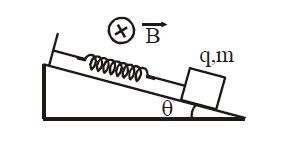
A small block of mass $m$, having charge $q$ is placed on frictionless inclined plane making an angle  $\theta$ with the horizontal. There exists a uniform magnetic field $B$ parallel to the inclined plane but  perpendicular to the length of spring. If $m$ is slightly pulled on the inclined in downward direction and released, the time period of oscillation will be (assume that the block does not leave contact with the plane)
A small cylindrical soft iron piece is kept in a galvanometer so that
A circular coil of conducting wire has an area $A$ and number of turns $N$. It is lying in a vertical plane in a region where uniform magnetic field $B$ exist with field direction normal to the coil plane. If the coil is rotated about a vertical axis by an angle $π$ in $0.5$ seconds, then the value of the emf induced at the ends of the coil is.
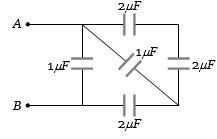
The total capacity of the system of capacitors shown in the adjoining figure between the points $A$ and $B$ is.....$\mu F$
The addition of antimony atoms to a sample of intrinsic germanium transforms it to a material which is
A body is in pure rotation. The linear speed $\nu$ of a particle, the distance r of the particle from the axis and the angular velocity $\omega$ of the body are related as $\omega=\frac{\text{v}}{\text{r}}$ Thus: