MCQ
Incorrect statement regarding Friedel craft alkylation is
  • A
    Aniline can not be alkylated by Friedel craft reaction
  • Polyalkylation is not possible
  • C
    Rearrangement will take place in presence of strong lewis acid like $AlCl_3$
  • D
    Nitrobenzene can be used as solvent during friedel craft alkylation
Answer

Correct option: B.
Polyalkylation is not possible
b

Need a full question paper?

Generate a complete, print-ready paper with questions like this in minutes — across 16+ boards, with answer keys.

Start Generating Free

Similar questions

Which of the following species do not exist?
A solution of sodium sulphate in water is electrolysed using platinum electrodes. The products at cathode and anode are respectively
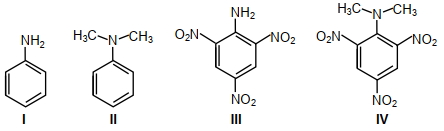
Consider the following four compounds $I, II, III,$ and $IV$.

Choose the correct statement($s$).

$(A)$ The order of basicity is $II > I > III > IV$ .

$(B)$ The magnitude of $p K_{ b }$ difference between $I$ and $II$ is more than that between $III$ and $IV$.

$(C)$ Resonance effect is more in $III$ than in $IV$.

$(D)$ Steric effect makes compound $IV$ more basic than $III$.

Reduction of nitroalkanes yields
Given below are two statements: one is labelled as Assertion $(A)$ and the other is labelled as Reason $(R)$. Assertion $(A)$: The total number of geometrical isomers shown by $\left[\mathrm{Co}(\mathrm{en})_2 \mathrm{Cl}_2\right]^{+}$complex ion is three

Reason $(R)$: $\left[\mathrm{Co}(\mathrm{en})_2 \mathrm{Cl}_2\right]^{+}$complex ion has an octahedral geometry.

In the light of the above statements, choose the most appropriate answer from the options given below :

Which of the following does not exhibit paramagnetic characteristics? (Atomic numbers $Ti =22 ; Fe =26$; $Cr =24 ; Cu =29$ )
On dissolving sugar in water at room temperature solution feels cool to touch. Under which of the following cases dissolution of sugar will be most rapid?
$8\,g$ of $NaOH$ is dissolved in $18\,g$ of $H_2O.$ Mole fraction of $NaOH$ in solution and molality (in $mol\,kg^{-1}$ ) of the solution respectively are
In thermal decomposition of metal carbonate the oxidation state of metal changed if metal is
${E^0} = \frac{{RT}}{{nF}}$ In ${K_{eq}}$. This is called