MCQ
Incorrect statement regarding $N(SiH_3)_3$ is
  • A
    It is associated with two type of hybridization of central atoms
  • B
    It is planar compound as a whole
  • $N-Si$ bond length is less than single bond
  • D
    It is weaker base than $NH_3$

Answer

Correct option: C.
$N-Si$ bond length is less than single bond
c

Need a full question paper?

Generate a complete, print-ready paper with questions like this in minutes — across 16+ boards, with answer keys.

Start Generating Free

Similar questions

Maximum enol content is in
Efficiency of a cell with cell reaction under standard conditions is $70\%$ cell reaction

${A_{\left( s \right)}} + {B^ \oplus } \longrightarrow {A^ \oplus } + {B_{\left( s \right)}}\,;\,\Delta {H^o} =  - 551.5\,KJ$ Calculate standard electrode potential of cell (in $volt$). .......... $\mathrm{volt}$

The pair of the compounds in which both the metals are in the highest possible oxidation state is
Assertion : $C -O$ bond in metal carbonyls is long.

Reason : There is delocalisation of electrons from filled $d$ orbitals into the empty orbitals on the $CO$ ligands.

Which of the following reagents convert propene to $1-$ propanol?
Hydrolysis of peroxo-disulphuric acid gives 
If three electrons could be accomodated in an orbital, then the element with atomic no $50$ will belong to:-
The standard reduction potential values of the three metallic cations $x, y, z$ are $0.52\, V, -3.03\,V$ and $-1.18\,V$ respectively. The order of reducing power of their corresponding metals will be
If $n$ & $l$ are principal and azimuthal quantum no. respectively then the expression for  calculating the total no. of electron in any energy level is :-
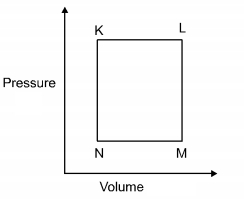
A fixed mass ' $m$ ' of a gas is subjected to transormation of states from $K$ to $L$ to $M$ to $N$ and back to $K$ as shown$Image$

$1.$ The succeeding operations that enable this transformation of states are

$(A)$ Heating, cooling, heating, cooling

$(B)$ Cooling, heating, cooling, heating

$(C)$ Heating, cooling, cooling, heating

$(D)$ Cooling, heating, heating, cooling

$2.$ The pair of isochoric processes among the transormation of states is

$(A)$ $K$ to $L$ and $L$ to $M$

$(B)$ $L$ to $M$ and $N$ to $K$

$(C)$ $L$ to $M$ and $M$ to $N$

$(D)$ $M$ to $N$ and $N$ to $K$

Give the answer question $1$ and $2.$