Question
Indicate the $\sigma$ and $\pi$ bonds in the following molecules:
$\mathrm{CH}_3 \mathrm{NO}_2$.

Answer


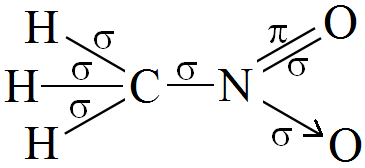
The $\sigma$ and $\pi$ bonds are indicated below:

$3\text{C}-\text{H }\sigma-\text{bonds}$
$1\text{C}-\text{N }\sigma-\text{bonds}$
$1\text{N}-\text{O }\sigma-\text{bond}$
$1\text{N}-\text{O }\pi -\text{bond}$

Need a full question paper?

Generate a complete, print-ready paper with questions like this in minutes — across 16+ boards, with answer keys.

Start Generating Free

Similar questions

Depict the galvanic cell in which the reaction $\mathrm{Zn}(\mathrm{s})+2 \mathrm{Ag}^{+}(\mathrm{aq}) \rightarrow \mathrm{Zn}^{2+}(\mathrm{aq})+2 \mathrm{Ag}(\mathrm{s})$ takes place, Further show:The carriers of the current in the cell.
Physical properties of ice, water and steam are very different. What is the chemical composition of water in all the three states.
The enthalpy of atomisation for the reaction $\mathrm{CH}_4(\mathrm{~g}) \rightarrow \mathrm{C}(\mathrm{g})+4 \mathrm{H}(\mathrm{g})$ is $16650 \mathrm{~kJ} \mathrm{~mol}^{-1}$. What is the bond energy of $\mathrm{C}-\mathrm{H}$ bond?
Liquid ammonia bottle is cooled before opening the seal. Why?
Explain the shapes of the following on the basis of VSEPR theory:
  1. $\text{BeCl}_2$
  2. $\text{PH}_4^+$
  3. $\text{PF}_5$
  4. $\text{SF}_6$
Name a species that will be isoelectronic with each of the following atoms or ions:
i. $\mathrm{Ne}$
ii. $\mathrm{Cl}^{-}$
iii. $\mathrm{Ca}^{2+}$
iv. $\mathrm{Rb}$
Account for the following observations:
$\mathrm{AlCl}_3$ is a Lewis acid.
What are pesticides and herbicides? Explain giving examples.
Arrange the following elements in increasing order of metallic character: B, Al, Mg and K.
Identify (A), (B), (C) and (D) and give their chemical formulae.
$\text{(A)}+\text{NaOH}\xrightarrow{\ \\ \ \ \\ \ \ \\ \ \ }\text{NaCl}+\text{NH}_3+\text{H}_2\text{O}$
$\text{(B)}+\text{NaCl}\xrightarrow{\ \\ \ \ \\ \ \ \\ \ \ }\text{(C)}+\text{NH}_4\text{Cl}$
$\text{(C)}\xrightarrow{\text{Heat}}\text{Na}_2\text{CO}_3+\text{H}_2\text{O}+\text{(D)}$