MCQ
Inorganic benzene is
  • A
    ${B_3}{H_3}{N_3}$
  • B
    $B{H_3}N{H_3}$
  • ${B_3}{H_6}{N_3}$
  • D
    ${H_3}{B_3}{N_6}$

Answer

Correct option: C.
${B_3}{H_6}{N_3}$
c
(c) Inorganic benzene is ${B_3}{H_6}{N_3}$

Need a full question paper?

Generate a complete, print-ready paper with questions like this in minutes — across 16+ boards, with answer keys.

Start Generating Free

Similar questions

Carbon and silicon belong to $(IV)$ group. The maximum coordination number of carbon in commonly occurring compounds is $4$, whereas that of silicon is $6$. This is due to
The total number of benzene derivatives with molecular formula $C_6H_3Cl_3$ is
A diatomic molecule has a dipole moment of $1.2\, D$ . If its bond length is equal to $10^{-10}\,m$ then the fraction of an electronic charge on each atom will be .............. $\%$
Which of the following is not Lewis acid
The correct order of increasing $s-$ character (in percentage) in the hybrid orbitals  of following molecules/ions is

$(I)\, CO^{2-}_3$      $(II)\, XeF_4$     $(III)\, I^-_3$  $(IV)\, NCl_3$   $(V)$ $BeCl_2$

How much ....$kJ$ energy is released when $6$ mole of octane is burnt in air ? Given $\Delta H_f^o$ for $C{O_2}(g),\,{H_2}O(g)$ and ${C_8}{H_{18}}(l)$ respectively are $-490,-240\, and + 160 \,kJ/mol$ 
The $71^{st}$ electron of an element $X$ with an atomic number of $71$ enters into the orbital:
Atomic number of an element is $26.$ The element shows
$2 \mathrm{SO}_{2}(\mathrm{~g})+\mathrm{O}_{2}(\mathrm{~g}) \rightarrow 2 \mathrm{SO}_{3}(\mathrm{~g})$

The above reaction is carried out in a vessel starting with partial pressure $\mathrm{P}_{\mathrm{SO}_{2}}=250\, \mathrm{~m}$ $bar,$ $\mathrm{P}_{0_{2}}=750 \,\mathrm{~m}$ $bar$ and $\mathrm{P}_{\mathrm{SO}_{3}}=0 \,\mathrm{bar}$. When the reaction is complete, the total pressure in the reaction vessel is $.....\mathrm{m}$ $bar.$ (Round off to the Nearest Integer).
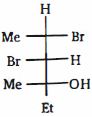
Which of the following is the enantiomer of the compound shown below ?