MCQ
Inorganic graphite is
  • A
    ${B_3}{N_3}{H_6}$
  • ${B_3}{N_3}$
  • C
    $SiC$
  • D
    $Fe{(CO)_5}$

Answer

Correct option: B.
${B_3}{N_3}$
b
Boron Nitride (BN) is also called Inorganic graphite.Boron nitride is a chemical compound with chemical formula BN, consisting of equal numbers of boron and nitrogen atoms. $BN$ is isoelectronic to a similarly structured carbon lattice and thus exists in various crystalline forms.

Need a full question paper?

Generate a complete, print-ready paper with questions like this in minutes — across 16+ boards, with answer keys.

Start Generating Free

Similar questions

A magnetic moment at $1.73\, BM$ will be shown by one among of the following
Although Zirconium belongs to 4d transition series and Hafnium to 5d transition series even then they show similar physical and chemical properties because ___________.
Proteins are found to have two different types of secondary structures viz. he lix and $\beta-$pleated sheet structure. $\alpha-$helix structure of protein is stabilized by:
The Gibbs energy change (in $J$) for the given reaction at $\left[ Cu ^{2+}\right]=\left[ Sn^{2+}\right]=1\, M$ and $298 \,K$ is:

$Cu ( s )+ Sn ^{2+}( aq ) \rightarrow Cu ^{2+}( aq )+ Sn ( s )$

$\left( E _{ Sn ^{2+} \mid Sn }^{0}=-0.16\, V , E _{ Cu ^{2+} \mid Cu }^{0}=0.34\, V \right.$ Take $F=96500\, C\, mol ^{-1}$ )

$\begin{array}{*{20}{c}}
  {2\,COOH} \\ 
  {|\,\,\,\,\,\,\,\,} \\ 
  {CHO}
\end{array}$ $\xrightarrow{{NaOH}}$ $\begin{array}{*{20}{c}}
  {COOH} \\ 
  {|\,\,\,\,\,\,\,\,\,\,\,} \\ 
  {\,\,\,\,\,\,\,\,C{H_2} - OH} 
\end{array}\,\,$    +    $\begin{array}{*{20}{c}}
  {COOH} \\ 
  {|\,\,\,\,\,\,\,\,\,\,\,} \\ 
  {\,\,\,\,\,\,\,\,COONa\,\,\,\,\,} 
\end{array}\,\,$ It is
The vapour pressure of pure water at $25\,^oC$ is $23.62\, mm$. What will be the vapour pressure of a solution of $1.5\, g$ urea in $50\, g$ water ? .......... $mm$
Calculate $E_{cell}^o$ of following galvanic cell at $298\, K$ ; ............ $\mathrm{V}$

 $Ca\left( s \right)|C{a^{ + 2}}_{\left( {aq.} \right)}||F{e^{ + 2}}_{\left( {aq} \right)}|Fe\left( s \right)$ 

$E_{C{a^{ + 2}}/Ca}^o =  - 2.87\,V$ ;  $E_{Fe/F{e^{ + 2}}}^o = 0.41\,V$
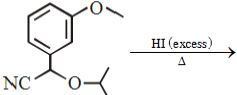
The major product of the following reaction is
A hybrid orbital formed from s-and p-orbital can contribute to:
An organic liquid A containing $C,H$ and  $O$  has a pleasant odour with a boiling point of ${78\,^o}C$ On boiling A with conc. ${H_2}S{O_4}$ a colourless gas is produced which decolourises bromine water and alkaline $KMn{O_4}.$ One mole of this gas also takes one mole of ${H_2}.$ The organic liquid $ A$  is