MCQ
Inside a horizontally moving box, an experimenter finds that when an object is placed on a smooth horizontal table and is released, it moves with an acceleration of $10\,m / s ^2$. In this box if $1\,kg$ body is suspended with a light string, the tension in the string in equilibrium position (w.r.t. experimenter) will be$.........\,N$ (Take $g =10\,m / s ^2$ )
  • A
    $10$
  • $10 \sqrt{2}$
  • C
    $20$
  • D
    $0$

Answer

Correct option: B.
$10 \sqrt{2}$
b
(b)

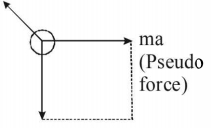
Acceleration of box $=10\,m / s ^2$Inside the box forces acting on bob are shown in the figure.

$T =\sqrt{( mg )^2+( ma )^2}=10 \sqrt{2}\,N$

Need a full question paper?

Generate a complete, print-ready paper with questions like this in minutes — across 16+ boards, with answer keys.

Start Generating Free

Similar questions

If the water falls from a dam into a turbine wheel $19.6\, m$ below, then the velocity of water at the turbines, is ..................  $\mathrm{m} / \mathrm{s}$ (take $g = 9.8\, m/s^2$)
If the projection of $2 \hat{i}+4 \hat{j}-2 \hat{k}$ on $\hat{i}+2 \hat{j}+\alpha \hat{k}$ is zero. Then, the value of $\alpha$ will be.
A body takes $4$ minutes to cool from ${100^o}C$ to ${70^o}C$. To cool from ${70^o}C$ to ${40^o}C$ it will take ........ $\min.$ (room temperature is ${15^o}C$)
One litre of oxygen at a pressure of $1\, atm$ and two litres of nitrogen at a pressure of $0.5\, atm$ are introduced into a vessel of volume $1L$. If there is no change in temperature, the final pressure of the mixture of gas (in $atm$) is
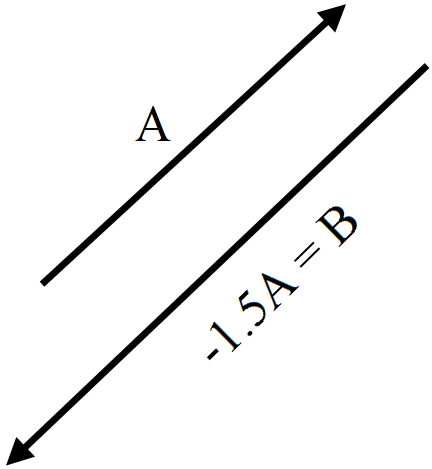
Choose the correct option regarding the given figure.

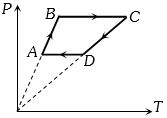
Six moles of an ideal gas perfomrs a cycle shown in figure. If the temperature are $T_A = 600 K, T_B = 800 K, T_C = 2200 K \,and\, T_D = 1200 K$, the work done per cycle is ..... $kJ$
Two discs having masses in the ratio $1: 2$ and radii in the ratio $1: 8$ roll down without slipping one by one from an inclined plane of height $h$. The ratio of their linear velocities on reaching the ground is ........
A metal ball of mass $2 \,kg$ moving with a velocity of $36 \,km/h$ has an head on collision with a stationary ball of mass $3 \,kg$. If after the collision, the two balls move together, the loss in kinetic energy due to collision is ........ $J$
The heavier nuclei tend to have larger $\frac{\text{N}}{\text{Z}}$ ratio because:
  1. A neutron is heavier than a proton.
  2. A neutron is an unstable particle.
  3. A neutron does not exert electric repulsion.
  4. Coulomb forces have longer range compared to the nuclear forces.
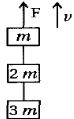
Three blocks with masses $m, 2m $ and $3 m$ are connected by strings, as shown in the figure. After an upward force $F$ is applied on block $m,$ the masses move upward at constant speed $v.$ What is the net force on the block of mass $2\ m\ ?\, (g$ is the acceleration due to gravity$)$