Question
$\int \frac{3 x+4}{\sqrt{2 x^2+2 x+1}} d x$

Answer

$\text { Let } I =\int \frac{3 x+4}{\sqrt{2 x^2+2 x+1}} d x$
Let $3 x +4= A \frac{ d }{ d x}\left(2 x^2+2 x+1\right)+ B$
$ \therefore 3 x+4=A(4 x+2)+B$
$\therefore 3 x+4=4 A x+2 A+B $
By equating the coefficients on both sides, we get
$4 A=3 \text { and } 2 A+B=4$
$\therefore A=\frac{3}{4} \text { and } 2\left(\frac{3}{4}\right)+B=4$
$\therefore B =\frac{5}{2}$
$ \therefore 3 x +4=\frac{3}{4}(4 x+2)+\frac{5}{2}$
$\therefore I =\int \frac{\frac{3}{4}(4 x+2)+\frac{5}{2}}{\sqrt{2 x^2+2 x+1}} d x$
$=\frac{3}{4} \int \frac{4 x+2}{\sqrt{2 x^2+2 x+1}} d x+\frac{5}{2} \int \frac{1}{\sqrt{2 x^2+2 x+1}} d x $ $ =I_1+I_2\ldots(i)$
$I_1=\frac{3}{4} \int \frac{4 x+2}{\sqrt{2 x^2+2 x+1}} d x $
Put $2 x^2+2 x+1=t$
$ \therefore(4 x +2) dx = dt$
$\therefore I _1=\frac{3}{4} \int \frac{ dt }{\sqrt{ t }}$
$=\frac{3}{4} \int t ^{\frac{1}{2}} dt$
$=\frac{3}{4}\left(\frac{ t ^{\frac{1}{2}}}{\frac{1}{2}}\right)+ c _1$
$=\frac{3}{2} \sqrt{ t }+ c _1$
$\therefore I _1=\frac{3}{2} \sqrt{2 x^2+2 x+1}+ c _1\ldots(i)$
$I _2=\frac{5}{2} \int \frac{1}{\sqrt{2 x^2+2 x+1}} d x$
$=\frac{5}{2} \int \frac{1}{\sqrt{2\left(x^2+x+\frac{1}{2}\right)}} d x $
 

Need a full question paper?

Generate a complete, print-ready paper with questions like this in minutes — across 16+ boards, with answer keys.

Start Generating Free

Similar questions

Show that $\frac{d y}{d x}=\frac{y}{x}$ in the following, where a and $p$ are constants.

$\cos ^{-1}\left(\frac{7 x^4+5 y^4}{7 x^4-5 y^4}\right)=\tan ^{-1} a$
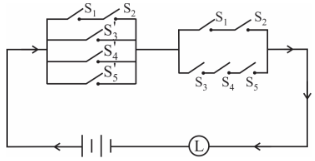
Simplify the following so that the new circuit has minimum number of switches. Also, draw the simplified circuit.
Image
If in a tetrahedron, edges in each of the two pairs of opposite edges are perpendicular, then show that the edges in the third pair are also perpendicular.
If $x =\frac{2 b t}{1+t^2}, y =a\left(\frac{1-t^2}{1+t^2}\right)$, show that $\frac{d x}{d y}=-\frac{b^2 y}{a^2 x}$
Write the negation of the statement “An angle is a right angle if and only if it is of measure 90°”
Show the equation $2 x^2+x y-y^2+x+4 y-3=0$ represents a pair of lines. Also find the acute angle between them.
A person’s assets start reducing in such a way that the rate of reduction of assets is proportional to the square root of the assets existing at that moment. If the assets at the beginning are ₹ 10 lakhs and they dwindle down to ₹ 10,000 after 2 years, show that theperson will be bankrupt in $2 \frac{2}{9}$ years from the start.
Given the p.d.f. (probability density function) of a continuous random variable $x$ as:
$\begin{aligned}
f(x) & =\frac{x^2}{3}, & -1& =0, & \text { otherwise }
\end{aligned}$
Determine the c.d.f. (cumulative distribution function) of $x$ and hence find
$P (x<1), P (x \leq-2), P (x>0), P (1
Solve the following differential equations:

$\left(1+e^{\frac{x}{y}}\right) d x+e^{\frac{x}{y}}\left(1-\frac{X}{y}\right) d y=0$

From a lot of 30 bulbs which include 6 defectives, a sample of 4 bulbs is drawn at random with replacement. Find the probability distribution of the number of defective bulbs.