MCQ
$\int_{}^{} {{{\cos }^5}x\;dx = } $
  • $\sin x - \frac{2}{3}{\sin ^3}x + \frac{1}{5}{\sin ^5}x + c$
  • B
    $\sin x + \frac{2}{3}{\sin ^3}x + \frac{1}{5}{\sin ^5}x + c$
  • C
    $\sin x - \frac{2}{3}{\sin ^3}x - \frac{1}{5}{\sin ^5}x + c$
  • D
    None of these

Answer

Correct option: A.
$\sin x - \frac{2}{3}{\sin ^3}x + \frac{1}{5}{\sin ^5}x + c$
a
(a)$\int_{}^{} {{{\cos }^5}x\,dx} = \int_{}^{} {{{\cos }^4}x\cos x\,dx} = \int_{}^{} {{{(1 - {{\sin }^2}x)}^2}\cos xdx} $
Put $\sin x = t \Rightarrow \cos x\;dx = dt$, then it reduces to
$\int_{}^{} {{{(1 - {t^2})}^2}dt = \int_{}^{} {(1 + {t^4} - 2{t^2})\;dt = \frac{{{t^5}}}{5} - \frac{{2{t^3}}}{3} + t + c} } $
$ = \frac{{{{\sin }^5}x}}{5} - \frac{{2{{\sin }^3}x}}{3} + \sin x + c$.

Need a full question paper?

Generate a complete, print-ready paper with questions like this in minutes — across 16+ boards, with answer keys.

Start Generating Free

Similar questions

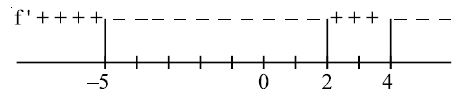
 $(i)$  $f (x)$ is continuous and defined for all real numbers

$(ii)$ $f '(-5) = 0 \,; \,f '(2)$ is not defined and $f '(4)  = 0$

$(iii)$ $(-5, 12)$ is a point which lies on the graph of $f (x)$

$(iv)$ $f ''(2)$ is undefined, but $f ''(x)$ is negative everywhere else.

$(v)$ the signs of  $f '(x)$ is given below

On the possible graph of $y = f (x)$ we have  
Solution of $\int x \sin x\ d x$ is $-$
The system of equations ${x_1} - {x_2} + {x_3} = 2,$ $\,3{x_1} - {x_2} + 2{x_3} = - 6$ and $3{x_1} + {x_2} + {x_3} = - 18$ has
If $f(x)=\sin \left(\cos ^{-1}\left(\frac{1-2^{2 x}}{1+2^{2 x}}\right)\right)$ and its first derivative with respect to $x$ is $-\frac{ b }{ a } \log _{ e } 2$ when $x =1,$ where $a$ and $b$ are integers, then the minimum value of $\left| a ^{2}- b ^{2}\right|$ is.........
The diameter of a circle is increasing at the rate of 1cm/sec. When its radius is $\pi$ the rate of increase of its area is:
$\int {(\sqrt {\tan x}  + \sqrt {\cot x} )} $ is equal to-
The value of the determinant $\begin{vmatrix} 5 &\text{amp; } 1 \\ 3 &\text{amp; } 2 \end{vmatrix}$
In a study about a pandemic, data of $900$ persons was collected. It was found that

$190$ persons had symptom of fever,

$220$ persons had symptom of cough,

$220$ persons had symptom of breathing problem,

$330$ persons had symptom of fever or cough or both,

$350$ persons had symptom of cough or breathing problem or both,

$340$ persons had symptom of fever or breathing problem or both,

$30$ persons had all three symptoms (fever, cough and breathing problem).

If a person is chosen randomly from these 900 persons, then the probability that the person has at most one symptom is. . . . .

If $\alpha=\tan^{-1}\Big(\frac{\sqrt3\text{x}}{2\text{y}-\text{x}}\Big),\beta=\tan^{-1}\Big(\frac{2\text{x}-\text{y}}{\sqrt3\text{y}}\Big),$ then $\alpha-\beta=$
$f(x) = \left\{ {\begin{array}{*{20}{c}}
  { - {x^3} + 1\,\,\,\,\,if\,\,\,\,\,\, - \infty  < x \leqslant 1} \\ 
  {|x - 1| + \lambda \,\,\,\,if\,\,\,\,\,\,\,\,\,\,\,\,x > 1} 
\end{array}} \right.$ then-