MCQ
$\int_{}^{} {\frac{{{a^x}}}{{\sqrt {1 - {a^{2x}}} }}dx = } $
  • $\frac{1}{{\log a}}{\sin ^{ - 1}}{a^x} + c$
  • B
    ${\sin ^{ - 1}}{a^x} + c$
  • C
    $\frac{1}{{\log a}}{\cos ^{ - 1}}{a^x} + c$
  • D
    ${\cos ^{ - 1}}{a^x} + c$

Answer

Correct option: A.
$\frac{1}{{\log a}}{\sin ^{ - 1}}{a^x} + c$
a
(a) Put ${a^x} = t \Rightarrow {a^x}{\log _e}a\,dx = dt,$ then
$\int_{}^{} {\frac{{{a^x}}}{{\sqrt {1 - {a^{2x}}} }}\,dx = \frac{1}{{{{\log }_e}a}}\int_{}^{} {\frac{{dt}}{{\sqrt {1 - {t^2}} }}} } $
$ = \frac{1}{{{{\log }_e}a}}{\sin ^{ - 1}}(t) + c = \frac{{{{\sin }^{ - 1}}({a^x})}}{{{{\log }_e}a}} + c$.

Need a full question paper?

Generate a complete, print-ready paper with questions like this in minutes — across 16+ boards, with answer keys.
Start Generating Free

Similar questions

If f(x) = |3 − x| + (3 + x), where (x) denotes the least integer greater than or equal to x, then f(x) is:
  1. Continuous and differentiable at x = 3
  2. Continuous but not differentiable at x = 3
  3. Differentiable nut not continuous at x = 3
  4. Neither differentiable nor continuous at x = 3
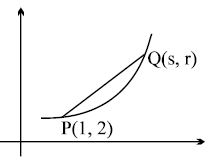
The graph of function $f$ contains the point $P (1, 2)$ and $Q(s, r)$. The equation of the secant line through $P$ and $Q$ is $y = \left( {\frac{{{s^2} + 2s - 3}}{{s - 1}}} \right)$ $x - 1 - s$. The value of $f ‘ (1)$, is
Derivative of ${\sec ^{ - 1}}\left\{ {{1 \over {2{x^2} - 1}}} \right\}$ w.r.t $\sqrt {1 + 3x} $ at $x = - {1 \over 3}$ is
The equation x² - x - 2 = 0 in three-dimensional space is represented by:
Choose the correct answers from the given four options:
If x = t2, y = t3, then $\frac{\text{d}^2\text{y}}{\text{dx}^2}$ is:
  1. $\frac{3}{2}$
  2. $\frac{3}{4\text{t}}$
  3. $\frac{3}{2\text{t}}$
  4. $\frac{3}{2\text{t}}$
The graph of the function $y = f (x)$ passing through the point $(0 , 1)$ and satisfying the differential equation $\frac{{dy}}{{dx}} + y \cos x = \cos x$ is such that
The shortest distance between the lines $\frac{x-2}{3}=\frac{y+1}{2}=\frac{z-6}{2}$ and $\frac{x-6}{3}=\frac{1-y}{2}=\frac{z+8}{0}$ is equal to $............$
Solution of differential equation $\frac{{dx}}{{dy}} = \frac{x}{{1 + x{e^y}\ cos\ {x^2}}}$ is 

(where $c $ is constant of integration)

For the matrix $A=\left[\begin{array}{ll}3 & 2 \\ 1 & 1\end{array}\right]$. find the number $a$ and $b$ such that $A^{2}+a A+b I=0$
If $y = 2x + {\cot ^{ - 1}}\,x + \log \left( {\sqrt {1 + {x^2}}  - x} \right),$ then $y$