MCQ
$\int_{}^{} {\frac{{\cos x - \sin x}}{{1 + \sin 2x}}\;dx = } $
  • $ - \frac{1}{{\cos x + \sin x}} + c$
  • B
    $\frac{1}{{\cos x + \sin x}} + c$
  • C
    $\frac{1}{{\cos x - \sin x}} + c$
  • D
    None of these

Answer

Correct option: A.
$ - \frac{1}{{\cos x + \sin x}} + c$
a
(a)$\int_{}^{} {\frac{{\cos x - \sin x}}{{1 + \sin 2x}}\,dx} = \int_{}^{} {\frac{{\cos x - \sin x}}{{{{(\sin x + \cos x)}^2}}}\,dx} $
Now put $\sin x + \cos x = t,$ then the $ \Rightarrow (\cos x - \sin x)\,dx = dt$ 

required integral is  $ - \frac{1}{{\sin x + \cos x}} + c$.

Need a full question paper?

Generate a complete, print-ready paper with questions like this in minutes — across 16+ boards, with answer keys.

Start Generating Free

Similar questions

If $y(x)=\cot ^{-1}\left(\frac{\sqrt{1+\sin x}+\sqrt{1-\sin x}}{\sqrt{1+\sin x}-\sqrt{1-\sin x}}\right), x \in\left(\frac{\pi}{2}, \pi\right)$ then $\frac{d y}{d x}$ at $x=\frac{5 \pi}{6}$ is:
If $\frac{\text{dy}}{\text{dx}}=\sin(\text{x}+\text{y})+\cos(\text{x}+\text{y}),\text{y}(0)=0,$ then $\tan\frac{\text{x}+\text{y}}{2}=$
Consider the function $f: \mathbb{R} \rightarrow \mathbb{R}$ defined by

$f(x)=\frac{2 x}{\sqrt{1+9 x^2}}$. If the composition of $f, \underbrace{(f \circ f \circ f \circ \ldots \circ f)}_{10 \text { times }}(x)=\frac{2^{10} x}{\sqrt{1+9 \alpha x^2}}$, then the value of $\sqrt{3 \alpha+1}$ is equal to....................

A bag contains $5$ red and $3$ blue balls. If $3$ balls are drawn at random without replacement, then the probability that exactly two of the three balls were red, the first ball being red, is
Let  ,  $f(x) = \min \left\{ {{{\sin }^{ - 1}}x,{{\cos }^{ - 1}}x} \right\}$ then area bounded by $f(x)$ and $x-$ axis is
Let $y=y(x)$ be the solution of the differential equation

$\frac{d y}{d x}=1+x e^{y-x},-\sqrt{2}\,<\,x\,<\,\sqrt{2}, y (0)=0$ then, the minimum value of $y(x)$ , $\mathrm{x} \in(-\sqrt{2}, \sqrt{2})$ is equal to:

Choose the correct answer out of the given four options.Let $*$ be binary operation defined on $R$ by $a * b = 1 + ab \forall a, b \in R.$ Then the operation $*$ is:
Let $r$ be a relation from $R$ (set of real numbers) to $R$ defined by $r = \{(a,b) \, | a,b \in R$  and  $a - b + \sqrt 3$ is an irrational number$\}$ The relation $r$ is
Let $\gamma \in R$ be such that the lines $L_1: \frac{x+11}{1}=\frac{y+21}{2}=\frac{z+29}{3}$ and $L_2: \frac{x+16}{3}=\frac{y+11}{2}=\frac{z+4}{\gamma}$ intersect. Let $R_1$ be the point of intersection of $L_1$ and $L_2$. Let $O=(0,0,0)$, and $\hat{n}$ denote a unit normal vector to the plane containing both the lines $L_1$ and $L_2$.

Match each entry in $List-I$ to the correct entry in $List-II$.

$List-I$ $List-II$
($P$) $\gamma$ equals ($1$) $-\hat{i}-\hat{j}+\hat{k}$
($Q$) A possible choice for $\hat{n}$ is ($2$) $\sqrt{\frac{3}{2}}$
($R$) $\overline{O R_1}$ equals ($3$) $1$
($S$) A possible value of $\overline{O R_1} \cdot \hat{n}$ is ($4$) $\frac{1}{\sqrt{6}} \hat{i}-\frac{2}{\sqrt{6}} \hat{j}+\frac{1}{\sqrt{6}} \hat{k}$
  ($5$) $\sqrt{\frac{2}{3}}$

The correct option is

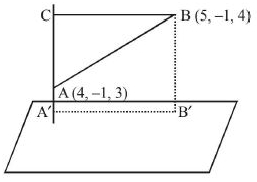
The length of the projection of the line segment joining the point  $\left( {5, - 1,4} \right)$ and $\left( {4, - 1,3} \right)$ on the plane $x + y + z = 7$ is :