MCQ
$\int_{}^{} {\frac{{dx}}{{x[{{(\log x)}^2} + 4\log x - 1]}}} = $
  • $\frac{1}{{2\sqrt 5 }}\log \left[ {\frac{{\log x + 2 - \sqrt 5 }}{{\log x + 2 + \sqrt 5 }}} \right] + c$
  • B
    $\frac{1}{{\sqrt 5 }}\log \left[ {\frac{{\log x + 2 - \sqrt 5 }}{{\log x + 2 + \sqrt 5 }}} \right] + c$
  • C
    $\frac{1}{{2\sqrt 5 }}\log \left[ {\frac{{\log x + 2 + \sqrt 5 }}{{\log x + 2 - \sqrt 5 }}} \right] + c$
  • D
    $\frac{1}{{\sqrt 5 }}\log \left[ {\frac{{\log x + 2 + \sqrt 5 }}{{\log x + 2 - \sqrt 5 }}} \right] + c$
Answer

Correct option: A.
$\frac{1}{{2\sqrt 5 }}\log \left[ {\frac{{\log x + 2 - \sqrt 5 }}{{\log x + 2 + \sqrt 5 }}} \right] + c$
a
(a) Put $\log x = t \Rightarrow \frac{1}{x}\,dx = dt,$ then
$\int_{}^{} {\frac{{dx}}{{x[{{(\log x)}^2} + 4\log x - 1]}}} = \int_{}^{} {\frac{{dt}}{{{t^2} + 4t - 1}}} $
$ = \int_{}^{} {\frac{{dt}}{{{{(t + 2)}^2} - {{(\sqrt 5 )}^2}}} = \frac{1}{{2\sqrt 5 }}\log \left[ {\frac{{t + 2 - \sqrt 5 }}{{t + 2 + \sqrt 5 }}} \right]} $
$ = \frac{1}{{2\sqrt 5 }}\log \left[ {\frac{{\log x + 2 - \sqrt 5 }}{{\log x + 2 + \sqrt 5 }}} \right] + c$.

Need a full question paper?

Generate a complete, print-ready paper with questions like this in minutes — across 16+ boards, with answer keys.

Start Generating Free

Similar questions

The function $f(x) = |x|$ at $x = 0$ is
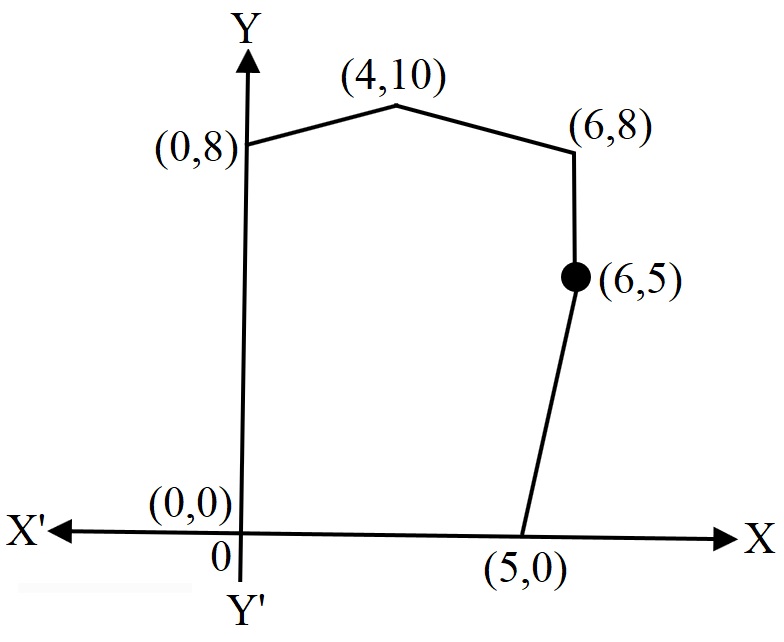
The feasible solution for a LPP is shown in the following figure. Let Z = 3x - 4y be the objective function.

Minimum of Z occurs at:

  1. (0, 0)
  2. (0, 8)
  3. (5, 0)
  4. (4, 10)
If A = {a, b, c, d}, then a relation R = {(a, b), (b, a), (a, a)} on A is:
  1. Symmetric and transitive only.
  2. Reflexive and transitive only.
  3. Symmetric only.
  4. Transitive only.
Let the solution curve $y=y(x)$ of the differential equation $\left(1+ e ^{2 x }\right)\left(\frac{ dy }{ dx }+ y \right)=1$ pass through the point $\left(0, \frac{\pi}{2}\right)$. Then, $\lim _{x \rightarrow \infty} e ^{x} y(x)$ is equal to.
A rifleman is firing at a distant target and has only 10% chance of hiting it. the least number of round he must fire in order to have more than 50% chance of hitting it at least once is:
  1. 11
  2. 9
  3. 7
  4. 5
A sphere of radius 100mm shrinks troximate decreo radius 98mm, then the appase in its volume is:
  1. $12000\pi\ \text{mm}^3$
  2. $800\pi\ \text{mm}^3$
  3. $80000\pi\ \text{mm}^3$
  4. $1200\pi\ \text{mm}^3$
The system of equations $x + y + z = 6$, $x + 2y + 3z = 10,x + 2y + \lambda z = \mu $, has no solution for

For a binomial variate X, if $\text{n}=3$ and $\text{P(X}=1)=8\text{ P(X = 3}),$ then p =

    The probability distribution of a discrete random variable X is given below:

    $\text{X}:$

    $2$

    $3$

    $4$

    $5$

    $\text{P}(\text{X}):$

    $\frac{5}{\text{k}}$

    $\frac{7}{\text{k}}$

    $\frac{9}{\text{k}}$

    $\frac{11}{\text{k}}$

    The value of k is:

    1. 8
    2. 16
    3. 32
    4. 48
    Let $(\alpha, \beta, \gamma)$ be the point $(8,5,7)$ in the line $\frac{x-1}{2}=\frac{y+1}{3}=\frac{z-2}{5}$. Then $\alpha+\beta+\gamma$ is equal to