MCQ
$\int_{}^{} {\frac{{\sin 3x}}{{\sin x}}\;dx = } $
  • $x + \sin 2x + c$
  • B
    $3x + \sin 2x + c$
  • C
    $3x + {\sin ^2}x + c$
  • D
    None of these

Answer

Correct option: A.
$x + \sin 2x + c$
a
(a)$\int_{}^{} {\frac{{\sin 3x}}{{\sin x}}\,dx} = \int_{}^{} {\frac{{3\sin x - 4{{\sin }^3}x}}{{\sin x}}\,dx} $
$\int_{}^{} {3\,dx} - 4\int_{}^{} {{{\sin }^2}x\,dx} = 3x - 2\int_{}^{} {(1 - \cos 2x)\,dx + c} $
$ = 3x - 2x + \sin 2x + c = x + \sin 2x + c.$

Need a full question paper?

Generate a complete, print-ready paper with questions like this in minutes — across 16+ boards, with answer keys.

Start Generating Free

Similar questions

If $y = \sin [\cos (\sin x)],$ then $dy/dx = $
If $\vec{\text{a}}$ and $\vec{\text{b}}$ be two unit vectors and $\theta$ the angle between them, than $\vec{\text{a}}+\vec{\text{b}}$ is a unit vector if $\theta=$
If $xy = {c^2},$ then minimum value of $ax + by$ is
What is the length of the longer diagonal of the parallelogram constructed on $5\vec{\text{a}}+2\vec{\text{b}}$ and $\vec{\text{a}}-3\vec{\text{b}}$ if it is given that $|\vec{\text{a}}|=2\sqrt{2},\big|\vec{\text{b}}\big|=3$ and the angle between $\vec{\text{a}}$ and $\vec{\text{b}}$ is $\frac{\pi}{4}$?
If the matrix $\left[ {\begin{array}{*{20}{c}}1&3&{\lambda + 2}\\2&4&8\\3&5&{10}\end{array}} \right]$ is singular, then $\lambda = $
The minimum value of the twice differentiable function $f(x)=\int_{0}^{x} e^{x-t} f^{\prime}(t) d t-\left(x^{2}-x+1\right) e^{x}, x \in R$, is.
If $\frac{{x - 1}}{l} = \frac{{y - 2}}{m} = \frac{{z + 1}}{n}$ is the equation of the line through $(1, 2, -1)$ and $(-1, 0, 1)$, then $(l, m, n)$ is
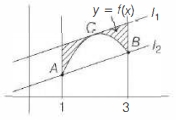
The following figure shows the graph of a continuous function $y=f(x)$ on the interval $[1,3]$. The points $A, B, C$ have coordinates $(1,1),(3,2),(2,3)$ respectively, and the lines $l_1$ and $l_2$ are parallel, with $l_1$ being tangent to the curve at $C$. If the area under the graph of $y=f(x)$ from $x=1$ to $x=3$ is $4$ sq units, then the area of the shaded region is
Integrating factor of the differential equation $\cos\text{x}\frac{\text{dy}}{\text{dx}}+\text{y}\sin\text{x}=1$ is:
The value of $\int\limits^{\pi}_0\frac{\text{x}\tan\text{x}}{\sec\text{x}+\cos\text{x}}\text{ dx}$ is: