MCQ
$\int_{}^{} {\frac{{{x^2} + 1}}{{{x^4} + 1}}dx = } $
  • A
    $\frac{1}{{\sqrt 2 }}{\tan ^{ - 1}}\left( {\frac{{{x^2} - 1}}{{2x}}} \right) + c$
  • B
    $\frac{1}{{\sqrt 2 }}{\tan ^{ - 1}}\left( {\frac{{{x^2} - 1}}{{\sqrt {2x} }}} \right) + c$
  • C
    $\frac{1}{{\sqrt 2 }}{\tan ^{ - 1}}\left( {\frac{{{x^2} - 1}}{{2\sqrt x }}} \right) + c$
  • $\frac{1}{{\sqrt 2 }}{\tan ^{ - 1}}\left( {\frac{{{x^2} - 1}}{{\sqrt 2 x}}} \right) + c$
Answer

Correct option: D.
$\frac{1}{{\sqrt 2 }}{\tan ^{ - 1}}\left( {\frac{{{x^2} - 1}}{{\sqrt 2 x}}} \right) + c$
d
(d)$\int_{}^{} {\frac{{{x^2} + 1}}{{{x^4} + 1}}} \,dx = \int_{}^{} {\frac{{\left( {1 + \frac{1}{{{x^2}}}} \right)}}{{\left( {{x^2} + \frac{1}{{{x^2}}}} \right)}}} \,dx = \int_{}^{} {\frac{{\left( {1 + \frac{1}{{{x^2}}}} \right)\,dx}}{{{{\left( {x - \frac{1}{x}} \right)}^2} + 2}}} $
Put $x - \frac{1}{x} = t \Rightarrow \left( {1 + \frac{1}{{{x^2}}}} \right)\,dx = dt,$ then the required integral is $\frac{1}{{\sqrt 2 }}{\tan ^{ - 1}}\left( {\frac{{{x^2} - 1}}{{\sqrt 2 x}}} \right) + c$.

Need a full question paper?

Generate a complete, print-ready paper with questions like this in minutes — across 16+ boards, with answer keys.

Start Generating Free

Similar questions

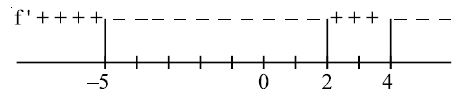
 $(i)$  $f (x)$ is continuous and defined for all real numbers

$(ii)$ $f '(-5) = 0 \,; \,f '(2)$ is not defined and $f '(4)  = 0$

$(iii)$ $(-5, 12)$ is a point which lies on the graph of $f (x)$

$(iv)$ $f ''(2)$ is undefined, but $f ''(x)$ is negative everywhere else.

$(v)$ the signs of  $f '(x)$ is given below

On the possible graph of $y = f (x)$ we have  

$\int\frac{\cos2\text{x}-1}{\cos2\text{x}+1}\text{ dx}=$
Suppose that $f (0) = - 3$ and $f ' (x) \le 5$ for all values of $x$. Then the largest value which $f (2)$ can attain is
$\int_{}^{} {\frac{{dx}}{{\tan x + \cot x}}} = $
The set of all values of $\lambda$ for which the system of linear  $2{x_1} - 2{x_2} + {x_3} = \lambda {x_1}\;,\;2{x_1} - 3{x_2} + 2{x_3} = \lambda {x_2}\;\;,$$\;\; - {x_1} + 2{x_2} = \lambda {x_3}$ has a non-trivial solution
$\int_{}^{} {{{\sec }^{2/3}}x\,{\rm{cose}}{{\rm{c}}^{4/3}}x\;dx = } $
The corner points of the feasible region determined by the system of linear constraints are (0, 10), (5, 5), (15, 15), (0, 20). Let Z = px + qy, where p, q > 0. Condition on p and q so that the maximum of Z occurs at both the points (15, 15) and (0, 20) is Maximum of Z occurs at:
The value of $(\hat{i} \times \hat{j}) \cdot \hat{j}+(\hat{j} \times \hat{i}) \cdot \hat{k}$ is:
If $a, b, c$ be positive real numbers and the value of $\theta = {\tan ^{ - 1}}\sqrt {\frac{{a(a + b + c)}}{{bc}}} + {\tan ^{ - 1}}\sqrt {\frac{{b(a + b + c)}}{{ca}}} + {\tan ^{ - 1}}\sqrt {\frac{{c(a + b + c)}}{{ab}}} $,then $\tan \theta $ is equal to
Let $f(x) = sin\,x,\,\,g(x) = x.$

Statement $1:$ $f(x)\, \le \,g\,(x)$ for $x$ in $(0,\infty )$

Statement $2:$ $f(x)\, \le \,1$ for $(x)$ in $(0,\infty )$ but $g(x)\,\to \infty$ as $x\,\to \infty$