MCQ
$\int_{}^{} {\frac{{{x^2} - 1}}{{{x^4} + {x^2} + 1}}\;dx = } $
  • A
    $\frac{1}{2}\log \left( {\frac{{{x^2} + x + 1}}{{{x^2} - x + 1}}} \right) + c$
  • B
    $\frac{1}{2}\log \left( {\frac{{{x^2} - x - 1}}{{{x^2} + x + 1}}} \right) + c$
  • C
    $\log \left( {\frac{{{x^2} - x + 1}}{{{x^2} + x + 1}}} \right) + c$
  • $\frac{1}{2}\log \left( {\frac{{{x^2} - x + 1}}{{{x^2} + x + 1}}} \right) + c$

Answer

Correct option: D.
$\frac{1}{2}\log \left( {\frac{{{x^2} - x + 1}}{{{x^2} + x + 1}}} \right) + c$
d
(d) The given function can be written as

$\int_{}^{} {\frac{{\left( {1 - \frac{1}{{{x^2}}}} \right)}}{{{{\left( {x + \frac{1}{x}} \right)}^2} - 1}}} \,dx$
Put $x + \frac{1}{x} = t \Rightarrow \left( {1 - \frac{1}{{{x^2}}}} \right)\,dx = dt,$ then it reduces to
$\int_{}^{} {\frac{{dt}}{{{t^2} - 1}}} = \frac{1}{2}\log \left| {\frac{{t - 1}}{{t + 1}}} \right| + c$
$ = \frac{1}{2}\log \left( {\frac{{x + \frac{1}{x} - 1}}{{x + \frac{1}{x} + 1}}} \right) + c = \frac{1}{2}\log \left( {\frac{{{x^2} - x + 1}}{{{x^2} + x + 1}}} \right) + c.$

Need a full question paper?

Generate a complete, print-ready paper with questions like this in minutes — across 16+ boards, with answer keys.

Start Generating Free

Similar questions

Order of $\Big(\frac{\text{dy}}{\text{dx}}+3\text{x}\Big)^\frac{3}{2}=\text{x}+\frac{3\text{dy}}{\text{dx}}$ is:
If the equation ${\sin ^{ - 1}}\left( {x - 1} \right) + {\cos ^{ - 1}}\left( {x - 3} \right) + {\tan ^{ - 1}}\left( {\frac{x}{{ - {x^2} + 2}}} \right) = m$ holds, then the value of $'m'$ is
Let for any three distinct consecutive terms $a, b, c$ of an $A.P,$ the lines $a x+b y+c=0$ be concurrent at the point $\mathrm{P}$ and $\mathrm{Q}(\alpha, \beta)$ be a point such that the system of equations $ x+y+z=6, $ $ 2 x+5 y+\alpha z=\beta$ and $x+2 y+3 z=4$, has infinitely many solutions. Then $(P Q)^2$ is equal to________.
The area of the region bounded by $y = | x – 1 |$ and $y = 1$ is:
If A is a square matrix, then AA is a:
The correct evaluation of $\int_0^{\pi /2} {\left| {\,\sin \left( {x - \frac{\pi }{4}} \right)\,} \right|\,dx} $ is
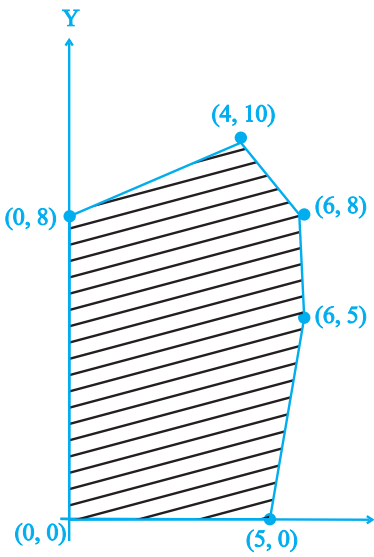
Choose the correct answer from the given four options. The feasible solution for a $\text{LPP}$ is shown in. Let $Z = 3x - 4y$ be the objective function. Maximum of $Z$ occurs at :
Let A = {1, 2, 3} and consider the relation R = {(1, 1), (2, 2), (3, 3), (1, 2), (2, 3), (1, 3)}. Then, R is:
The vectors $\vec{\text{a}}$ and $\vec{\text{b}}$ satisfy the equation $2\vec{\text{a}}+\vec{\text{b}}=\vec{\text{p}}$ and $\vec{\text{a}}+2\vec{\text{b}}=\vec{\text{q}},$ where $\vec{\text{p}}=\hat{\text{i}}+\hat{\text{j}}$ and $\vec{\text{q}}=\hat{\text{i}}-\hat{\text{j}}.$ If $\theta$ is the angle between $\vec{\text{a}}$ and $\vec{\text{b}},$ then:
$\tan \left[ {\frac{\pi }{4} + \frac{1}{2}{{\cos }^{ - 1}}\frac{a}{b}} \right] + \tan \left[ {\frac{\pi }{4} - \frac{1}{2}{{\cos }^{ - 1}}\frac{a}{b}} \right] = $