MCQ
$\int_{}^{} {\frac{{{x^2} + 1}}{{{x^4} - {x^2} + 1}}\;dx = } $
  • A
    ${\tan ^{ - 1}}\left( {\frac{{1 + {x^2}}}{x}} \right) + c$
  • B
    ${\cot ^{ - 1}}\left( {\frac{{1 + {x^2}}}{x}} \right) + c$
  • ${\tan ^{ - 1}}\left( {\frac{{{x^2} - 1}}{x}} \right) + c$
  • D
    ${\cot ^{ - 1}}\left( {\frac{{{x^2} - 1}}{x}} \right) + c$

Answer

Correct option: C.
${\tan ^{ - 1}}\left( {\frac{{{x^2} - 1}}{x}} \right) + c$
c
(c)$\int_{}^{} {\frac{{{x^2} + 1}}{{{x^4} - {x^2} + 1}}\,dx = \int_{}^{} {\frac{{\left( {1 + \frac{1}{{{x^2}}}} \right)}}{{{x^2} + \frac{1}{{{x^2}}} - 1}}} } $
$ = \int_{}^{} {\frac{{1 + \frac{1}{{{x^2}}}}}{{{{\left( {x - \frac{1}{x}} \right)}^2} + 1}}\,dx = \int_{}^{} {\frac{{dt}}{{{t^2} + 1}}} = {{\tan }^{ - 1}}t + c} $
$\left\{ {{\rm{Putting}}\,x - \frac{1}{x} = t \Rightarrow \left( {1 + \frac{1}{{{x^2}}}} \right)\,dx = dt} \right\}$
$ = {\tan ^{ - 1}}\left( {x - \frac{1}{x}} \right) + c = {\tan ^{ - 1}}\left( {\frac{{{x^2} - 1}}{x}} \right) + c.$

Need a full question paper?

Generate a complete, print-ready paper with questions like this in minutes — across 16+ boards, with answer keys.

Start Generating Free

Similar questions

Choose the correct answer out of the given four options.Let T be the set of all triangles in the Euclidean plane and let a relation R on T be defined as aRb, if a is congruent to $\text{b}\ \forall\ \text{a},\ \text{b}\in\text{T}.$ Then, R is:
If $\overrightarrow x  = 3\hat i - 6\hat j - \hat k$ , $\overrightarrow y  = \hat i + 4\hat j - 3\hat k$ and $\,\,\overrightarrow z  = 3\hat i - 4\hat j - 12\hat k$ , then the magnitude of the projection of $\overrightarrow x  \times \overrightarrow y $ on $\overrightarrow z$ is
The position vectors of four points  $ P, Q, R, S$  are $2a + 4c,\,$ $5a + 3\sqrt 3 \,b + 4c,$ $ - 2\sqrt 3 b + c$ and $2a + c$ respectively, then
If $\text{A}=\begin{bmatrix} 2 & 0 & 0 \\ 0 & 2 & 0 \\ 0 & 0 & 2 \end{bmatrix},$ then $A^5 =$
The number of distinct real roots of $\begin{vmatrix}\text{cosec}&\sec\text{x}&\sec\text{x}\\\sec\text{x}&\text{cosec}\text{x}&\sec\text{x}\\\sec\text{x}&\sec\text{x}&\text{cosecx}\end{vmatrix}=0$ lies in the interval $-\frac{\pi}{4}\leq\text{x}\leq\frac{\pi}{4}$ is:
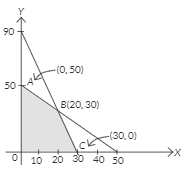
The maximum value of $Z=4 x+y$ for a $\text{L.P.P.}$ whose feasible region is given below is:
Image
The value of definite integral $\int\limits_0^{\frac{1}{2}} {\frac{{\ln \left( {1 + 2x} \right)}}{{1 + 4{x^2}}}} \,dx$ , equals
The two parts of  $100 $ for which the sum of double of first and square of second part is minimum, are
Let $f( x)$ be a polynomial of degree four having extreme values at $ x=1 $ and $ x=2$ . If $\mathop {\lim }\limits_{x \to 0} \left[ {1 + \frac{{f\left( x \right)}}{{{x^2}}}} \right] = 3$,then $f\left( 2 \right)$ is equal to :
If $\overline{\text{a}},\overline{\text{b}},\overline{\text{c}}$ are unit vectors such that $\overline{\text{a}}+\overline{\text{b}}+\overline{\text{c}}+\overline{\text{c.a}}=$