MCQ
$\int_{}^{} {\frac{{{{({x^4} - x)}^{1/4}}}}{{{x^5}}}\;dx} $ is equal to
  • $\frac{4}{{15}}{\left( {1 - \frac{1}{{{x^3}}}} \right)^{5/4}} + c$
  • B
    $\frac{4}{5}{\left( {1 - \frac{1}{{{x^3}}}} \right)^{5/4}} + c$
  • C
    $\frac{4}{{15}}{\left( {1 + \frac{1}{{{x^3}}}} \right)^{5/4}} + c$
  • D
    None of these

Answer

Correct option: A.
$\frac{4}{{15}}{\left( {1 - \frac{1}{{{x^3}}}} \right)^{5/4}} + c$
a
(a)$\int_{}^{} {\frac{{{{({x^4} - x)}^{1/4}}}}{{{x^5}}}\,dx} = \int_{}^{} {\frac{1}{{{x^4}}}{{\left( {1 - \frac{1}{{{x^3}}}} \right)}^{1/4}}dx} $
$ = \frac{1}{3}\int_{}^{} {{t^{1/4}}dt} = \frac{4}{{15}}{t^{5/4}} + c = \frac{4}{{15}}{\left( {1 - \frac{1}{{{x^3}}}} \right)^{5/4}} + c$
$\left\{ {{\rm{Putting}}\,1 - \frac{1}{{{x^3}}} = t\,{\rm{and}}\,\frac{1}{{{x^4}}}\,dx = \frac{1}{3}\,dt} \right\}$

Need a full question paper?

Generate a complete, print-ready paper with questions like this in minutes — across 16+ boards, with answer keys.

Start Generating Free

Similar questions

Find the area of the triangle with vertices $P(4,5), Q(4,-2)$ and $R(-6,2)$.
If ${x^p}{y^q} = {(x + y)^{p + q}}$, then $\frac{{{d^2}y}}{{d{x^2}}} = $
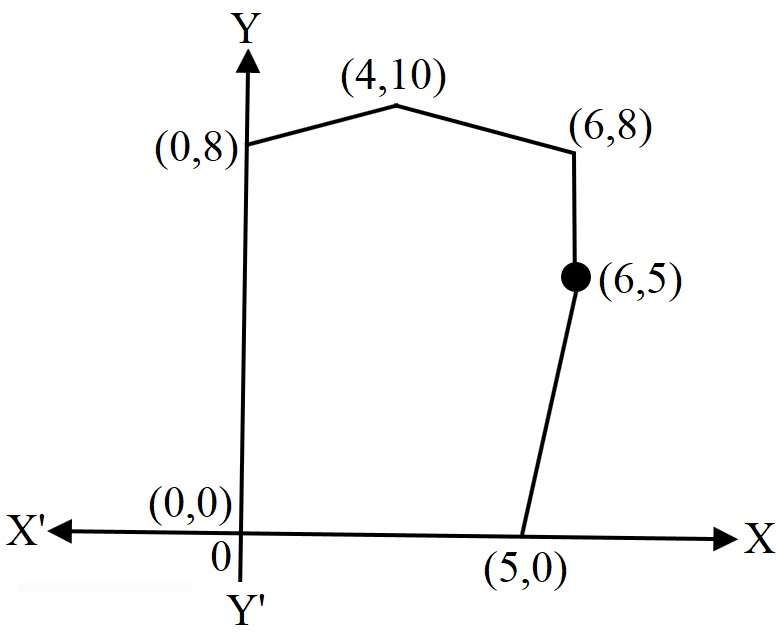
The feasible solution for a LPP is shown in the following figure. Let Z = 3x - 4y be the objective function.

Minimum of Z occurs at:


If $y = {\tan ^{ - 1}}\sqrt {{{a - x} \over {a + x}}} $, then ${{dy} \over {dx}} = $
Linear programming used to optimize mathematical procedure and is:
Consider the following statements on a set $A=\{1,2,3\}$ :
(i) $\quad R=\{(1,1),(2,2)\}$ is a reflexive relation on $A$.
(ii) $R=\{(3,3)\}$ is symmetric and transitive but not a reflexive relation on $A$.
Which of the statements given above is/are correct?
Consider the cube in the first octant with sides $OP, OQ $and $OR$ of length $1$ , along the $x$-axis, $y$-axis and $z$-axis, respectively, where $O (0,0,0)$ is the origin. Let $S \left(\frac{1}{2}, \frac{1}{2}, \frac{1}{2}\right)$ be the centre of the cube and $T$ be the vertex of the cube opposite to the origin $O$ such

that $S$ lies on the diagonal OT. If $\overrightarrow{ p }=\overrightarrow{ SP }, \overrightarrow{ q }=\overrightarrow{ SQ }, \overrightarrow{ r }=\overrightarrow{ SR }$ and $\overrightarrow{ t }=\overrightarrow{ ST }$, then the value of $|(\overrightarrow{ p } \times \overrightarrow{ q }) \times(\overrightarrow{ r } \times \overrightarrow{ t })|$ is. . . . . . .. 

Let $\text{A}=\{\text{x}\in\text{R}:\text{x}\leq1\}$ and $f : A \rightarrow A$ be defined as $f(x) = x(2 - x).$ Then $f^{-1}(x)$ is:
If the lines $\text{x}- \frac{2}{1} =\text{y}-\frac{2}{1} =\text{z}-\frac{4}{\text{k}} $ and $\text{x}-\frac{1}{\text{k}} = \text{y}-\frac{4}{2} = \text{z}-\frac{5}{1} $ are coplanar, then $k$ can have:
If $\vec{a}, \vec{b}, \vec{c}$ are unit vectors such that $\vec{a}+\vec{b}+\vec{c}=\overrightarrow{0}$, then the value of $\vec{a} \cdot \vec{b}+\vec{b} \cdot \vec{c}+\vec{c} \cdot \vec{a}$ is