MCQ
$\int_{}^{} {{e^{2x + \log x}}} dx = $
  • $\frac{1}{4}(2x - 1){e^{2x}} + c$
  • B
    $\frac{1}{4}(2x+ 1){e^{2x}} + c$
  • C
    $\frac{1}{2}(2x - 1){e^{2x}} + c$
  • D
    $\frac{1}{2}(2x + 1){e^{2x}} + c$

Answer

Correct option: A.
$\frac{1}{4}(2x - 1){e^{2x}} + c$
a
(a)$\int_{}^{} {{e^{2x + \log x}}dx} = \int_{}^{} {x{e^{2x}}dx} $
$ = \frac{{x{e^{2x}}}}{2} - \int_{}^{} {\frac{1}{2}{e^{2x}}dx + c} = \frac{{{e^{2x}}}}{4}(2x - 1) + c.$

Need a full question paper?

Generate a complete, print-ready paper with questions like this in minutes — across 16+ boards, with answer keys.
Start Generating Free

Similar questions

The general solution of the trigonometric equation $tan\, x + tan \,2x + tan\, 3x = tan \,x · tan\, 2x · tan \,3x$ is
Three defective oranges are accidently mixed with seven good ones and on looking at them, it is not possible to differentiate between them. Two oranges are drawn at random from the lot. If $x$ denote the number of defective oranges, then the variance of x is :
${d \over {dx}}\left( {{{\cos }^{ - 1}}\sqrt {{{1 + \cos x} \over 2}} } \right) = $
If for $\theta \in\left[-\frac{\pi}{3}, 0\right]$, the points $(x, y)=\left(3 \tan \left(\theta+\frac{\pi}{3}\right), 2 \tan \left(\theta+\frac{\pi}{6}\right)\right)$ lie on
$x y+\alpha x+\beta y+\gamma=0$, then $\alpha^{2}+\beta^{2}+\gamma^{2}$ is equal to :
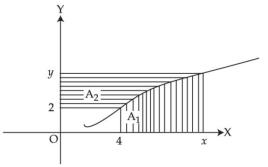
Consider a curve $y=y(x)$ in the first quadrant as shown in the figure. Let the area $A_{1}$ is twice the area $A _{2}$. Then the normal to the curve perpendicular to the line $2 x -12 y =15$ does NOT pass through the point.
Let $A=\left[a_{i j}\right]$ be a real matrix of order $3 \times  3$, such that $a_{i 1}+a_{i 2}+a_{i 3}=1,$ for $i=1,2,3$. Then, the sum of all the entries of the matrix $A^{3}$ is equal to:
Let the common tangents to the curves $4\left(x^{2}+y^{2}\right)=$ $9$ and $y ^{2}=4 x$ intersect at the point $Q$. Let an ellipse, centered at the origin $O$, has lengths of semi-minor and semi-major axes equal to $OQ$ and $6$ , respectively. If $e$ and $l$ respectively denote the eccentricity and the length of the latus rectum of this ellipse, then $\frac{l}{ e ^{2}}$ is equal to
The inequality $|z - 4|\, < \,|\,z - 2|$represents the region given by
If the roots of the equation $a{x^2} + bx + c = 0$be $\alpha $and $\beta $, then the roots of the equation $c{x^2} + bx + a = 0$ are
In which interval is the given function $f(x) = 2{x^3} - 15{x^2} + 36x + 1$ is monotonically decreasing