MCQ
$\int {{e^{\sin x}}\left( {\sin x + {{\sec }^2}x} \right)} \,dx$ is equal to
  • ${e^{\sin x}}.\tan x + C$
  • B
    ${e^{\sin x}}.\sec x + C$
  • C
    ${e^{\sin x}}.\cot x + C$
  • D
    None of these

Answer

Correct option: A.
${e^{\sin x}}.\tan x + C$
a
$\begin{array}{l}
\int {{e^{\sin x}}\left( {\cos x\tan x + {{\sec }^2}x} \right)} \,dx\\
 = {e^{\sin x}}\tan x + C
\end{array}$

Need a full question paper?

Generate a complete, print-ready paper with questions like this in minutes — across 16+ boards, with answer keys.
Start Generating Free

Similar questions

Let R be the relation over the set of all straight lines in a plane such that  $\text{l}_1\text{Rl}_2\Leftrightarrow\text{l}_1\bot\text{l}_2.$ Then, R is:
  1. Symmetric.
  2. Reflexive.
  3. Transitive.
  4. An equivalence relation.
Two fair dice, each with faces numbered $1,2,3,4,5$ and $6$ , are rolled together and the sum of the numbers on the faces is observed. This process is repeated till the sum is either a prime number or a perfect square. Suppose the sum turns out to be a perfect square before it turns out to be a prime number. If $p$ is the probability that this perfect square is an odd number, then the value of $14 p$ is. . . . . 
Solution of differential equation $\frac{{dy}}{{dx}} = \sin x + 2x$, is
The value of $\int_{-\pi / 2}^{\pi / 2}\left(x^3+x \cos x+\tan 5 x+1\right) d x$ is
Two or more vectors having the same initial point are:
  1. Coinitial vectors
  2. colinear vectors
  3. equal vectors
  4. Cannot say
Let $A=\{1,3,4,6,9\}$ and $B=\{2,4,5,8,10\}$. Let $R$ be a relation defined on $A \times B$ such that $R =$ $\left\{\left(\left(a_1, b_1\right),\left(a_2, b_2\right)\right): a_1 \leq b_2\right.$ and $\left.b_1 \leq a_2\right\}$. Then the number of elements in the set $R$ is
$\mathop \smallint \limits_3^6 \frac{{\sqrt x }}{{\sqrt {9 - x} + \sqrt x }}\;dx = $
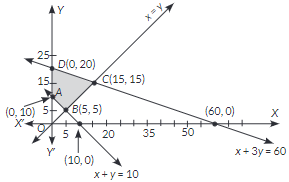
Based on the given shaded region as the feasible region in the graph, at which point(s) is the objective function $Z=3 x+9 y$ maximum?
Image
$\left( {\vec a \times \vec b} \right) \times \left[ {\left( {\vec b \times \vec c} \right) \times \left( {\vec a \times \vec b + \vec b \times \vec c + \vec c \times \vec a} \right)} \right]$ is
The perimeter of the triangle whose vertices have the position vectors $(i + j + k),\,\,(5i + 3j - 3k)$ and $(2i + 5j + 9k),$ is given by