MCQ
$\int_{}^{} {{e^x}\left( {\frac{1}{x} - \frac{1}{{{x^2}}}} \right)} \,dx = $
  • A
    $ - \frac{{{e^x}}}{{{x^2}}} + c$
  • B
    $\frac{{{e^x}}}{{{x^2}}} + c$
  • $\frac{{{e^x}}}{x} + c$
  • D
    $ - \frac{{{e^x}}}{x} + c$

Answer

Correct option: C.
$\frac{{{e^x}}}{x} + c$
c
(c)$\int_{}^{} {{e^x}\left( {\frac{1}{x} - \frac{1}{{{x^2}}}} \right)} \,dx = {e^x}\frac{1}{x} + c$
Since, we have $\int_{}^{} {{e^x}\left\{ {f(x) + f'(x)} \right\}\,dx} = {e^x}f(x) + c.$

Need a full question paper?

Generate a complete, print-ready paper with questions like this in minutes — across 16+ boards, with answer keys.
Start Generating Free

Similar questions

If $\begin{bmatrix}2\text{x}+\text{y}&4\text{x}\\5\text{x}-7&4\text{x}\end{bmatrix}=\begin{bmatrix}7&7\text{y}-13\\\text{y}&\text{x}+6\end{bmatrix},$ then the value of x and y is:
Let $\mathrm{A}(-1,1)$ and $\mathrm{B}(2,3)$ be two points and $\mathrm{P}$ be a variable point above the line $A B$ such that the area of $\triangle \mathrm{PAB}$ is $10$ . If the locus of $\mathrm{P}$ is $\mathrm{ax}+\mathrm{by}=15$, then $5 a+2 b$ is :
If $f: R \rightarrow R$ and $g: R \rightarrow R$ defined by $f(x)=2 x+3$ and $g(x)=x^2+7$, then the value of $x$ for which $f(g(x))=25$ is:
Let $a,\,\,b,\,\,c$ be non-zero real numbers such that
$\int_0^3 {(3a{x^2} + 2bx + c)\,dx} = \int_1^3 {(3a{x^2} + 2bx + c} )\,dx\,,$ then
If $A$ is the area bounded by curves $y = |cosx|,$$ y = 5 - \frac{4}{\pi } | x - \pi |,$ in $\ x  \in  [0, 2\pi]$ , then value of $\left( {\frac{A}{2} + 2} \right)$ is
The general solution of a differential equation of the type $\frac{d x}{d y}+ P _1 x= Q _1$ is
If $g(x)=x^2+x-2$ and $\frac{1}{2} \operatorname{gof}(x)=2 x^2-5 x+2$, then $f(x)$ is equal to:
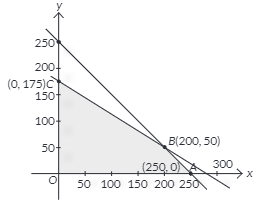
The corner points of the bounded feasible region of an LPP are $O(0,0), A(250,0), B(200,50)$ and $C(0,175)$. If the maximum value of the objective function $Z=2 a x+$ by occurs at the points $A(250,0)$ and $B(200,50)$, then the relation between $a$ and $b$ is:
Image
If $A^5 = 0$ Such that $\text{A}^{\text{n}}\neq\text{I for }1\leq\text{n}\leq4,\text{ then}(\text{I}-\text{A})^{-1}$ equals:
If $a \times b = b \times c \ne 0,$ where $a, b$  and $ c$  are coplanar vectors, then for some scalar $ k$