MCQ
$\int_{}^{} {[f(x)\,g''(x) - f''(x)\,g(x)]\,dx} $=
  • A
    $\frac{{f(x)}}{{g'(x)}}$
  • B
    $f'(x)g(x) - f(x)g'(x)$
  • $f(x)g'(x) - f'(x)g(x)$
  • D
    $f(x)g'(x) + f'(x)g(x)$

Answer

Correct option: C.
$f(x)g'(x) - f'(x)g(x)$
c
(c)$\int_{}^{} {[f(x)\,g''(x) - f''(x)\,g(x)]\,dx} $
$ = \int_{}^{} {f(x)\,g''(x)\,dx} - \int_{}^{} {f''(x)\,g(x)\,dx} $
$ = \left( {f(x)\,g'(x) - \int_{}^{} {f'(x)g'(x)\,dx} } \right) - \left( {g(x)\,f'(x) - \int_{}^{} {g'(x)\,f'(x)\,dx} } \right)$
$ = f(x)\,g'(x) - f'(x)\,g(x).$

Need a full question paper?

Generate a complete, print-ready paper with questions like this in minutes — across 16+ boards, with answer keys.
Start Generating Free

Similar questions

Objective of linear programming for an objective function is to:
If A = {a, b, c}, then the relation R = {(b, c)} on A is:
Let $\alpha x=\exp \left(x^\beta y^\gamma\right)$ be the solution of the differential equation $2 x^2 y d y-\left(1-x y^2\right) d x=0$, $x >0, y (2)=\sqrt{\log _e 2}$. Then $\alpha+\beta-\gamma$ equals :
$\int_{0}^{\frac{\pi}{2}}\sqrt{1+\sin2\text{x}}\text{dx}$ is equal to:
If $A =$ $\left[ {\begin{array}{*{20}{c}}a&b\\c&d\end{array}} \right]$ (where $bc \ne 0$) satisfies the equations $x^2 + k = 0$, then
The distance of the point $(-1, -5, -10)$ from the point of intersection of the line $\vec{\text{r}}.=2\hat{\text{i}}-\hat{\text{j}}+2\hat{\text{k}}+\lambda(3\hat{\text{i}}+4\hat{\text{j}}+12\hat{\text{k}})$ and the plane $\vec{\text{r}}.=(\hat{\text{i}}-\hat{\text{j}}+\hat{\text{k}})=5$ is:
The area bounded by the curve $\text{y}=\cos\text{x}$ in one are of the curve is where $=4\text{n}+1,\text{x}\in \text{integer:}$
Let $D_1 =$ $\left| {\,\begin{array}{*{20}{c}}a&b&{a + b}\\c&d&{c + d}\\a&b&{a - b}\end{array}\,} \right|$ and $D_2 =$ $\left| {\,\begin{array}{*{20}{c}}a&c&{a + c}\\b&d&{b + d}\\a&c&{a + b + c}\end{array}\,} \right|$ then the value of $\frac{{{D_1}}}{{{D_2}}}$ where $b \ne 0$ and $ad \ne bc$, is
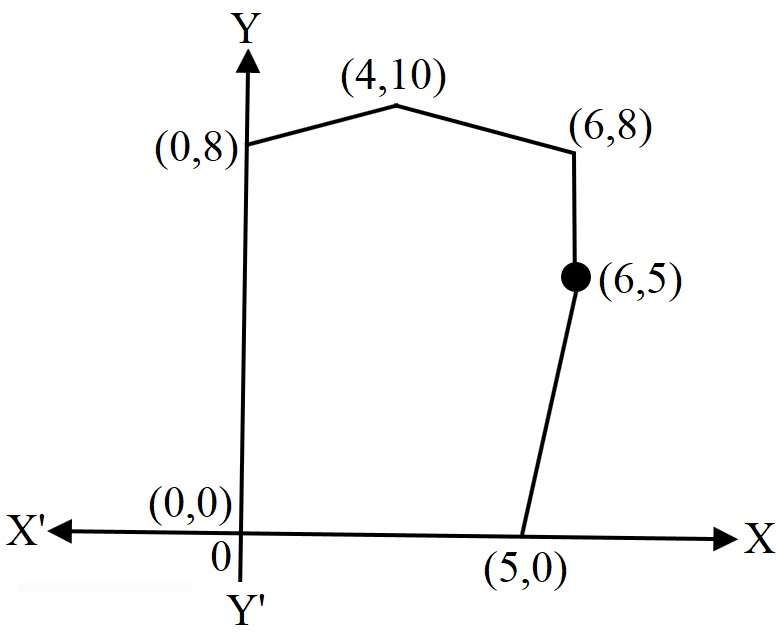
The feasible solution for a LPP is shown in the following figure. Let Z = 3x - 4y be the objective function.

Minimum of Z occurs at:


If $f(x) = \left\{ \begin{array}{l}\frac{1}{x}\sin {x^2},\,x \ne 0\\\,\,\,\,\,\,\,\,\,\,\,\,\,\,0,\,x = 0\end{array} \right.$, then