MCQ
$\int_{}^{} {{{\tan }^2}x\;dx} $ is equal to
  • A
    $\tan x + x + c$
  • $\tan x - x + c$
  • C
    $\sec x + x + c$
  • D
    $\sec x - x + c$

Answer

Correct option: B.
$\tan x - x + c$
b
(b)$\int_{}^{} {{{\tan }^2}x\,dx} = \int_{}^{} {({{\sec }^2}x - 1)\,dx} = \tan x - x + c$.

Need a full question paper?

Generate a complete, print-ready paper with questions like this in minutes — across 16+ boards, with answer keys.

Start Generating Free

Similar questions

$\int\frac{\sin\text{x}}{3+4\cos^2\text{x}}\text{ dx}=$
  1. $\log(3+4\cos^2\text{x})+\text{C}$
  2. $\frac{1}{2\sqrt{3}}\tan^{-1}\Big(\frac{\cos\text{x}}{\sqrt{3}}\Big)+\text{C}$
  3. $-\frac{1}{2\sqrt{3}}\tan^{-1}\Big(\frac{2\cos\text{x}}{\sqrt{3}}\Big)+\text{C}$
  4. $\frac{1}{2\sqrt{3}}\tan^{-1}\Big(\frac{2\cos\text{x}}{\sqrt{3}}\Big)+\text{C}$
The solution of the equation $\frac{{dy}}{{dx}} = \frac{{x + y}}{{x - y}}$ is
The differential equation satisfied by $\text{ax}^{2}+\text{by}^{2}=1$ is:
  1. $\text{xyy}_{2}+\text{y}_{1}^{2}+\text{yy}_{1}=0$
  2. $\text{xyy}_{2}+\text{xy}_{1}^{2}-\text{yy}_{1}=0$
  3. $\text{xyy}_{2}+\text{xy}_{1}^{2}+\text{yy}_{1}=0$
  4. None of these. 
If $\big[2\vec{\text{a}}+4\vec{\text{b}}\vec{\text{c}}\vec{\text{d}}\big]=\lambda\big[\vec{\text{a}}\vec{\text{c}}\vec{\text{d}}\big]+\mu\big[\vec{\text{b}}\vec{\text{c}}\vec{\text{d}}\big],$ then $\lambda+\mu=$
  1. 6
  2. -6
  3. 10
  4. 8
If $\frac{d}{d x}(f(x))=4 x^3-\frac{3}{x^4}$ and $f(2)=0$, then $f(x)=$ __________ .
Let $f:[-1,2] \rightarrow[0, \infty)$ be a continuous function such that $f(x)=f(1-x)$ for all $x \in[-1,2]$. Let $R_1=\int_{-1}^2 x f(x) d x$, and $R_2$ be the area of the region bounded by $y=f(x), x=-1, x=2$, and the $x$-axis. Then
If $\text{f(x)}=\begin{cases}\text{mx}+1,&\text{x}\leq\frac{\pi}{2}\\\sin\text{x}+\text{n},&\text{n}>\frac{\pi}{2}\end{cases}$ is continuous at $\text{x}=\frac{\pi}{2},$ then:
  1. $\text{m}=1,\text{ n}=0$
  2. $\text{m}=\frac{\text{n}\pi}{2}+1$
  3. $\text{n}=\frac{\text{m}\pi}{2}$
  4. $\text{m}=\text{n}=\frac{\pi}{2}$
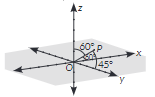
A line $\overrightarrow{O P}$ in space, represented by the figure below; has a magnitude of $2 \sqrt{2}$ units.
Image
Which of these are the direction ratios of $\overrightarrow{O P}$ ?
A line makes an angle $\alpha,\beta,\gamma$ with the X, Y, Z axes. Then $\sin^2\alpha+\sin^2\beta+\sin^2\gamma=$
If $y = {x^n}\log x + x{(\log x)^n}$, then ${{dy} \over {dx}} = $