MCQ
$\int_{}^{} {{{(\tan x - \cot x)}^2}\;dx = } $
- A$\tan x + \cot x + c$
- B$\sec x\tan x + c$
- C$\cos {\rm{ec}}x\cot x + c$
- ✓None of these
Generate a complete, print-ready paper with questions like this in minutes — across 16+ boards, with answer keys.
$E=\left[\begin{array}{ccc}1 & 2 & 3 \\ 2 & 3 & 4 \\ 8 & 13 & 18\end{array}\right], P=\left[\begin{array}{lll}1 & 0 & 0 \\ 0 & 0 & 1 \\ 0 & 1 & 0\end{array}\right]$ and $F=\left[\begin{array}{ccc}1 & 3 & 2 \\ 8 & 18 & 13 \\ 2 & 4 & 3\end{array}\right]$
If $Q$ is a nonsingular matrix of order $3 \times 3$, then which of the following statements is (are) $TRUE$?
$(A)$F $=P E P$ and $P^2=\left[\begin{array}{lll}1 & 0 & 0 \\ 0 & 1 & 0 \\ 0 & 0 & 1\end{array}\right]$
$(B)$ $\left| EQ + PFQ ^{-1}\right|=| EQ |+\left| PFQ ^{-1}\right|$
$(C)$ $\left|( EF )^3\right|>| EF |^2$
$(D)$ Sum of the diagonal entries of $P ^{-1} EP + F$ is equal to the sum of diagonal entries of $E + P ^{-1} FP$
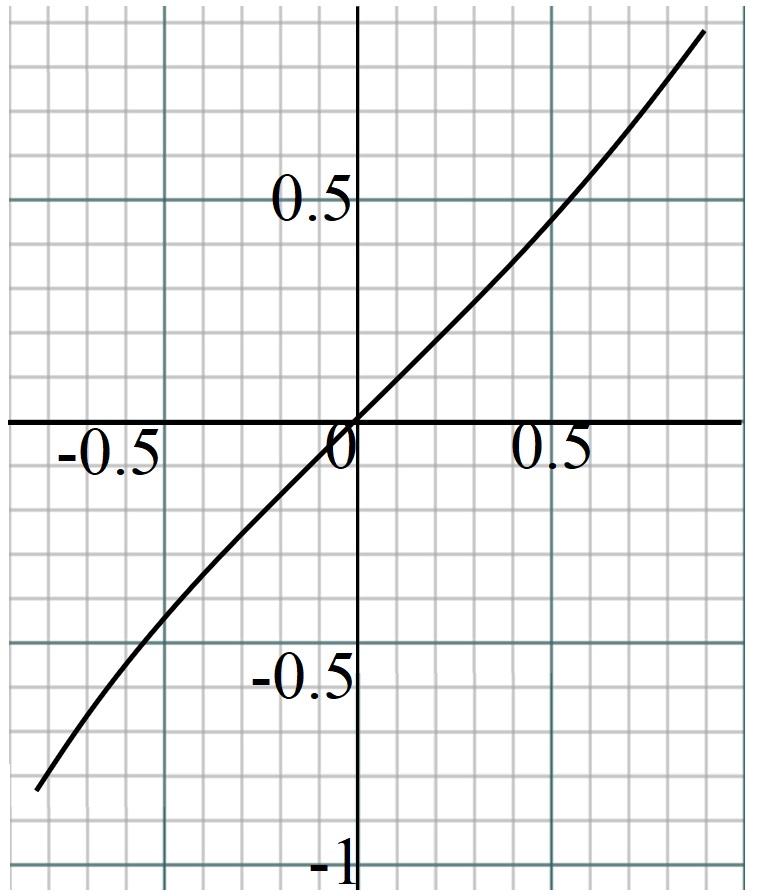
$\text{y} = \sin-1\text{x}$
$\text{y} = \text{cosec }\text{x}$
$\text{y} = \sec\text{x}$
Let $z=8 x+12 y$ be the objective function. Match the following :
$(i)$ Minimum value of $z$ occurs at $\ldots$
$(ii)$ Maximum value of $z$ occurs at $\ldots$
$(iii)$ Maximum of $z$ is $\ldots$
$(iv)$ Minimum of $z$ is $\ldots \ldots$
$I$. Domain of $f\left((g(x))^2\right)=$ Domain of $f(g(x))$
$II$. Domain of $f(g(x))+g(f(x))=$ Domain of $g(f(x))$
$III$. Domain of $f(g(x))=$ Domain of $g(f(x))$
$IV.$ Domain of $g\left((f(x))^3\right)=$ Domain of $f(g(x))$