MCQ
$\int_0^1 {\frac{{{e^x}(x - 1)}}{{{{(x + 1)}^3}}}\,dx = } $
  • A
    $\frac{e}{4}$
  • $\frac{e}{4} - 1$
  • C
    $\frac{e}{4} + 1$
  • D
    None of these

Answer

Correct option: B.
$\frac{e}{4} - 1$
b
(b) $\int_0^1 {\frac{{{e^x}(x - 1)}}{{{{(x + 1)}^3}}}} dx = \int_0^1 {\frac{{{e^x}(x + 1 - 2)}}{{{{(x + 1)}^3}}}\,} dx$

$\int_0^1 {\frac{{{e^x}}}{{{{(x + 1)}^2}}}} dx - 2\int_0^1 {\frac{{{e^x}}}{{{{(x + 1)}^3}}}} dx = \left[ {\frac{{{e^x}}}{{{{(x + 1)}^2}}}} \right]_0^1 $

$= \frac{e}{4} - 1$.

Need a full question paper?

Generate a complete, print-ready paper with questions like this in minutes — across 16+ boards, with answer keys.
Start Generating Free

Similar questions

Let $f (\theta)=\sin \theta+\int_{-\pi / 2}^{\pi / 2}(\sin \theta+ t \cos \theta) f ( t ) dt$. Then the value of $\left|\int_{0}^{\pi / 2} f (\theta) d \theta\right|$ is
The order and the degree of the differential equation $\left(1+3 \frac{d y}{d x}\right)^2=4 \frac{d^3 y}{d x^3}$ respectively, are
Choose the correct answer in Exercise:
$\int\frac{\text{dx}}{\sqrt{9\text{x}-4\text{x}^2}}\text{equals}$
  1. $\frac{1}{9}\sin^{-1}\bigg(\frac{9\text{x}-8}{8}\bigg)+\text{C}$
  2. $\frac{1}{2}\sin^{-1}\bigg(\frac{8\text{x}-9}{9}\bigg)+\text{C}$
  3. $\frac{1}{3}\sin^{-1}\bigg(\frac{9\text{x}-8}{8}\bigg)+\text{C}$
  4. $\frac{1}{2}\sin^{-1}\bigg(\frac{9\text{x}-8}{9}\bigg)+\text{C}$
If $x\frac{{dy}}{{dx}} + y = x\frac{{f\left( {xy} \right)}}{{f'\left( {xy} \right)}}$ , then $f(xy)$ is equal to
If the integral $\int_{0}^{10} \frac{[\sin 2 \pi x ]}{ e ^{ x -[ x ]}} dx =\alpha e ^{-1}+\beta e ^{-\frac{1}{2}}+\gamma$, where $\alpha, \beta, \gamma$ are integers and $[ x ]$ denotes the greatest integer less than or equal to $x$, then the value of $\alpha+\beta+\gamma$ is equal to ........ .
If $\int_0^{\frac{\pi}{4}} \frac{\sin ^2 x}{1+\sin x \cos x} d x=\frac{1}{a} \log _e\left(\frac{a}{3}\right)+\frac{\pi}{b \sqrt{3}}$, where a, $\mathrm{b} \in \mathrm{N}$, then $\mathrm{a}+\mathrm{b}$ is equal to ....................
Choose the correct answer
If $\theta$ is the angle between any two vectors $\vec{\text{a}}\ \text{and}\ \vec{\text{b}}, \text{then}\ |\vec{\text{a}}\cdot\vec{\text{b}}|=|\vec{\text{a}}\times\vec{\text{b}}|\ \text{when}\ \theta$ is equal to
  1. 0
  2. $\frac{\pi}{4}$
  3. $\frac{\pi}{2}$
  4. $\pi$
If the position vectors of two point $ P $ and $Q $ are respectively $9i - j + 5k$ and $i + 3j + 5k$, and the line segment $PQ$  intersects the $ YOZ$  plane at a point $ R,$  the $PR : RQ$ is equal to
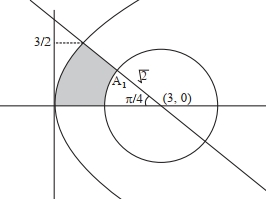
If the area bounded by the curve $2 y^2=3 x$, lines $x+y=3, y=0$ and outside the circle $(x-3)^2+y^2=2$ is $A$, then $4(\pi+4 A )$ is equal to $.........$.
The area of the region bounded by the curve x = 2y + 3 and lines y = 1 and y = –1 is:
  1. $4\text{ sq.}\text{ units}$
  2. $\frac{2}{3}\text{ sq.}\text{ units}$
  3. $6\text{ sq.}\text{ units}$
  4. $8\text{ sq.}\text{ units}$